





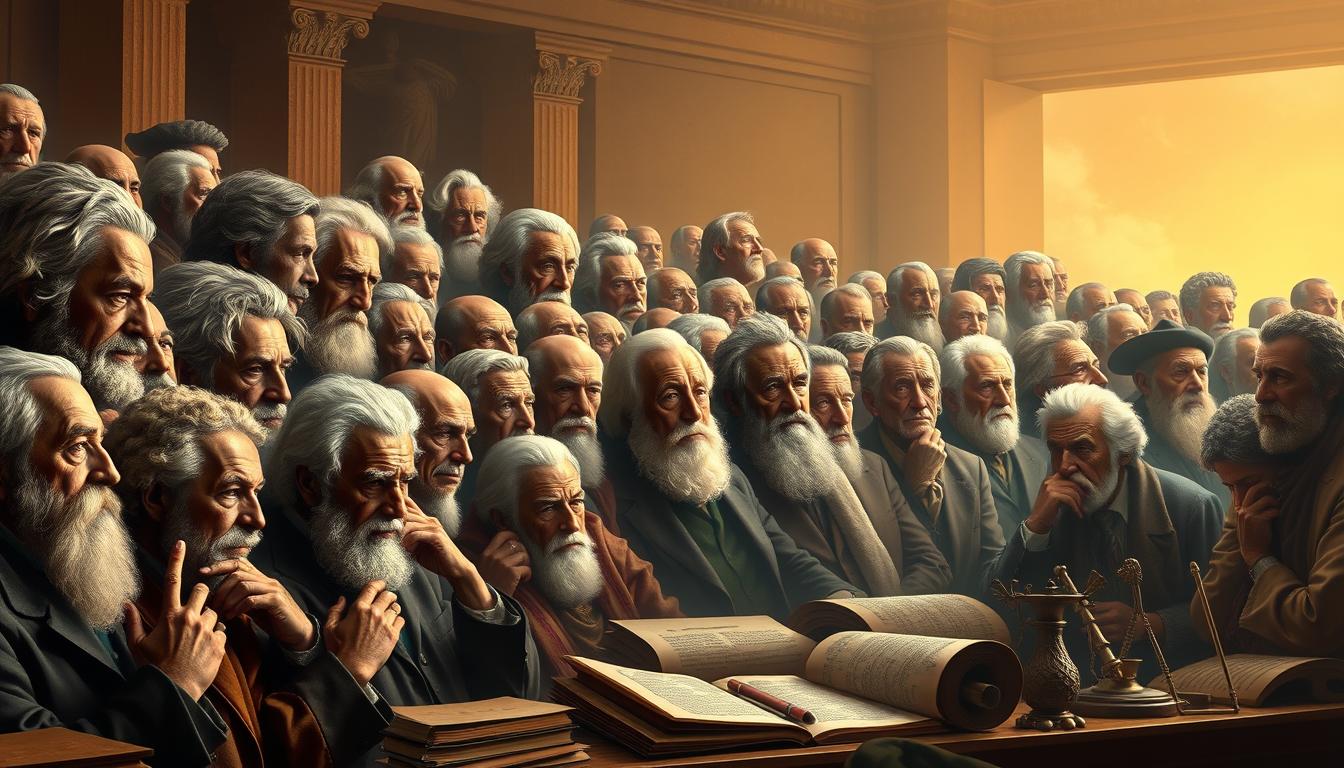
History’s greatest thinkers changed the world with their ideas. They shaped governments and made scientific breakthroughs. From ancient philosophers like Plato to Enlightenment thinkers like Voltaire, they challenged the status quo and inspired progress.
Will Durant listed 10 thinkers, from Aristotle to Charles Darwin. Their work, along with events like the Renaissance and Enlightenment, shows the power of curiosity and innovation. By looking at these figures, we see how individual brilliance can lead to lasting change, affecting everything from politics to science.
Introduction to History’s Greatest Thinkers
Humans are the only species with the ability to transform themselves. The very dignity of humans lies precisely in their ability to make themselves into what they aspire to be.
Thinkers like Socrates and Einstein changed the history of ideas by questioning accepted norms. Their work is key to intellectual history. It shows that progress comes from minds willing to challenge the status quo.
These visionaries were known for their curiosity and courage. Their breakthroughs, whether in philosophy or science, often came during tough times. These moments sparked intellectual movements that changed societies. Their philosophical progress is more than just individual talent; it’s a mix of bold ideas and a world ready to listen.
Education and cultural openness help shape who can contribute to these movements. From ancient academies to today’s universities, places that foster critical thinking drive change. Their stories teach us that great minds don’t just record history; they create it.
The Philosophical Giants of Ancient Greece
Athens became the birthplace of Western philosophy. Thinkers like Socrates, Plato, and Aristotle shaped ideas that are relevant today. Socrates, known for questioning everything, used a method that challenged assumptions. His legacy lives on through Plato’s dialogues.
Plato founded the Academy in Athens, the first school dedicated to learning. His work The Republic explored ethics and governance. He believed reality exists beyond the physical world.
“The unexamined life is not worth living,” Socrates declared before his execution for “corrupting youth.”
Aristotle, Plato’s student, expanded logic and observation. His works on ethics, biology, and politics laid the groundwork for science. Even his mistakes, like denying Earth’s movement, showed the value of inquiry.
Pre-Socratics like Heraclitus and Parmenides debated reality’s nature. Later, Stoicism and Epicureanism offered different views of the good life. These ideas, born in Greek city-states, became the blueprint for Western thought.
Enlightenment Thinkers Who Changed Society
In the Age of Enlightenment, thinkers put reason and science first. John Locke and Rousseau questioned old ways of ruling. Locke said governments protect our natural rights like life and liberty.
Rousseau then said power comes from the people, not just rulers. He wrote about this in The Social Contract.
Voltaire stood up for freedom of speech and religion. He said, “I disapprove of what you say, but I will defend to the death your right to say it.” His words sparked revolutions.
His ideas helped create the American Declaration of Independence and France’s 1789 revolution. These events ended the rule of monarchs and the clergy.
The Enlightenment legacy helped build modern democracies. Montesquieu’s ideas about power separation are in many constitutions today. Their work on education, secular governments, and human rights continues to guide us.
The Innovations of the Scientific Revolution
Copernicus sparked the scientific revolution by saying Earth orbits the sun. His idea, shared in 1543, changed how we see our place in the universe. Galileo then used a telescope to prove it, showing the power of the scientific method.
His fight with the Church showed how new ideas challenge old beliefs.

Newton brought together the study of the sky and the earth with his laws of motion and gravity. His work in 1687 showed math could predict nature’s patterns. This made empirical evidence the base of science.
Darwin’s theory of evolution changed biology, explaining life’s variety through natural selection. These discoveries replaced old beliefs with knowledge we can test and repeat.
Francis Bacon and René Descartes made the scientific method better. They turned curiosity into a plan for discovery. Their work led to many advances, from vaccines to space travel.
Each thinker added to our tools for understanding the world. They showed that curiosity can reveal universal truths.
The Impact of Political Philosophers
Political theory has grown thanks to thinkers who changed how we see power. Niccolò Machiavelli’s The Prince moved us from idealism to practical leadership. He showed how rulers use power in real life. His ideas help us understand the complex world of governance.
Karl Marx and communism challenged the capitalist system, seeing history as a fight between classes. His ideas sparked global movements, from the 1917 Russian revolution to today’s debates on wealth inequality. John Stuart Mill’s utilitarianism said decisions should make society better, shaping liberal democracies’ values of freedom and the common good.
Hannah Arendt’s work on totalitarianism showed how systems like Nazi Germany took away people’s humanity. Her insights on the dangers of authoritarianism are as relevant today as ever. These thinkers’ ideas continue to shape discussions on justice, freedom, and the state’s role in society.
From Machiavelli’s practical approach to Marx’s critique of capitalism, their theories shape political thought. Mill’s utilitarianism and Arendt’s insights into power structures keep influencing debates. The evolution of political theory shows how ideas can change—or shake up—societies.
Great Minds of the 19th Century
The 19th century was a time of big changes and new ideas. 19th century intellectuals faced the challenges of industrialization and science. Thinkers like Kierkegaard and Nietzsche asked people to find their own truth in a changing world.
Their ideas made people question old beliefs. They sparked debates that are relevant today.

“God is dead,” declared Nietzsche, capturing the era’s existential shift. His writings on power and morality reshaped philosophy.
Freud’s early work started Freud’s psychoanalysis, exploring the mind’s depths. Industrial revolution thinkers like Karl Marx and Friedrich Engels looked at class struggles. They believed capitalism would lead to socialist revolutions.
Their ideas changed global politics. Auguste Comte began sociology, aiming to solve social problems through knowledge.
Darwin’s impact went beyond biology. His ideas inspired Herbert Spencer’s “survival of the fittest” concept. This idea was wrongly applied to human societies.
John Stuart Mill pushed for actions that benefit everyone. He believed in utilitarian ethics.
These thinkers changed how we see society, science, and ourselves. Their work connects to today’s psychology, politics, and ethics. The 19th century was a key time for modern thought.
20th Century Visionaries and Their Ideas
20th century philosophers faced big challenges like world wars and new technologies. Einstein’s relativity changed science, merging time and space into one. This idea changed how we see reality, from art to ethics.
Ludwig Wittgenstein focused on language, saying meaning comes from how we use words. His 1921 Tractatus Logico-Philosophicus and later works changed how we think about language and meaning.
“The limits of my language mean the limits of my world,” Wittgenstein wrote, linking thought to linguistic boundaries.
Existentialism was a response to the chaos of war. Jean-Paul Sartre and Simone de Beauvoir said we must find our own meaning in life. They believed existence comes before essence, urging us to create our own purpose.
The cognitive revolution, led by Noam Chomsky, looked into our innate mental structures. It connected philosophy with neuroscience. Postmodernists like Jacques Derrida questioned big, universal truths, focusing on the details instead.
Karl Popper and Michel Foucault changed how we see knowledge. Postmodernism, led by Jean-François Lyotard, rejected big theories. It showed how context matters more than absolute truths.
These ideas changed many fields, from literature to politics. They show a century of both progress and doubt. Wittgenstein’s work and Einstein’s theories are key to understanding our world today.
Women Who Shaped Intellectual Discourse
Women philosophers have long challenged societal norms, shaping ideas despite systemic exclusion. Mary Wollstonecraft’s 1792 work A Vindication of the Rights of Woman laid groundwork for feminist theory, arguing for women’s education and intellectual equality. Her writings remain a cornerstone of gender studies today.

Simone de Beauvoir reshaped philosophy in 1949 with The Second Sex, declaring
“one is not born, but becomes, a woman.”
This explored how society constructs gender roles, cementing her as a leader in feminist thought. Decades later, bell hooks expanded this legacy, blending race, class, and gender in works likeAin’t I a Woman?, deepening feminist theory’s intersectional scope.
Hannah Arendt’s political philosophy, including her analysis of totalitarianism in The Origins of Totalitarianism, challenged dominant male-centric frameworks. Despite their impact, women philosophers face persistent barriers: in 2013, only 3.6% of philosophy citations named female authors. Even today, women make up under 20% of philosophy faculty in many institutions.
These thinkers prove intellectual progress demands diverse voices. From Mary Astell’s 1700 critiques of gendered education to Olympe de Gouges’ 1791 Declaration of the Rights of Woman, their ideas echo across centuries. Their legacy urges us to confront biases and amplify underrepresented minds.
The Role of Thinkers in Modern Technology
Modern tech breakthroughs come from technology philosophers who ask big questions. Computing pioneers like Alan Turing and Claude Shannon set the stage. Turing worked on computation, and Shannon’s information theory laid the groundwork for our digital world.
Silicon Valley visionaries like Steve Jobs and Tim Berners-Lee took these ideas further. Berners-Lee created the open web, focusing on teamwork. Jobs combined technology with a focus on people.
Marshall McLuhan’s famous saying, “The medium is the message,” is more relevant today. It shows how platforms change how we communicate.
Digital revolution thinkers like Sherry Turkle examine AI and social media’s impact on us. Experts like Kate Crawford discuss AI ethics, making sure tech respects our privacy and fairness. From Descartes to today’s AI debates, we’re always asking: What does it mean to be human in a tech world?
Lessons from History’s Greatest Thinkers
Intellectual history teaches us that breakthroughs come from traits of genius like curiosity and resilience. Thinkers like Aristotle and Enlightenment philosophers showed how creative thinking patterns—questioning norms and connecting ideas—drove progress. Their stories reveal innovation psychology in action, where challenges spark new solutions.
“Man is by nature a social animal,” Aristotle noted, highlighting how intellectual movements thrive in collaborative environments. History’s innovators, from Renaissance polymaths to pandemic-era volunteers, prove that crises can unite people toward shared goals.
Modern challenges like climate change echo past dilemmas. Thomas Malthus warned of population strains, mirroring today’s debates on resource scarcity. The NHS volunteers during the pandemic mirrored the communal spirit of ancient Athens, where democracy fueled intellectual growth. Even Ayn Rand’s controversial ideas remind us how self-interest and altruism clash in innovation.

Today’s innovators can learn from historical innovation psychology. Cross-disciplinary approaches, like those of Leonardo da Vinci or modern tech pioneers, show that blending fields sparks breakthroughs. Schools and companies can nurture these traits of genius by encouraging risk-taking and curiosity. As Hayek cautioned, balancing urgency with long-term vision ensures progress isn’t overshadowed by panic.
Whether addressing pandemics or inequality, history’s thinkers remind us: progress demands courage to rethink the impossible.
Conclusion: Legacy of History’s Greatest Thinkers
Theintellectual legacyof thinkers like Socrates, who said“I know that I know nothing,”shapes today’s debates. Plato’s Academy, started in 387 BC, mixed philosophy with education. Now, courses like the 32-lecture series on Plato’s dialogues show how old questions are relevant today.
Aristotle’s logic and Kant’sCritique of Pure Reasonhelped create today’s science and ethics. These thinkers built the foundations for our modern world.
Thecultural impact of philosophyis clear. Nietzsche’s ideas about the “death of God” reflect today’s society. Confucius’ ethics influence governance, and Augustine’sConfessionsmix personal thoughts with theology, staying relevant.
Asthought evolutionspeeds up, we face new challenges like information overload. Lecture #33 talks about connecting different fields, just like Plato did.
Thefuture of thinkingdepends on keeping intellectual courage alive. Today’s puzzles, from quantum physics to AI, need the depth of Aristotle and Socrates’ humility. The course says our research is just the start.
Education and teamwork will keep this legacy going. The Academy’s 800-year history shows ideas last longer than empires. Let’s continue their work by asking big questions, pushing limits, and celebrating theintellectual legacythat leads us forward.
Further Reading and Resources
Start your next adventure with a philosophy reading list. It includes key philosophical texts like Confucius’ Analects and Plato’s Republic. You can also dive into works by Nietzsche and Foucault, like The Gay Science and Discipline and Punish. These texts explore power and ethics.
For a modern twist, check out Sand Talk by Tyson Yunkaporta and Principles by Ray Dalio. They link ancient wisdom to today’s problems.
Online online philosophy courses on Coursera and YouTube channels like Wisecrack make complex ideas easy to grasp. You can also find intellectual history resources for free on digital archives and podcasts. Will Durant suggests spending seven hours a week reading to gain deep understanding.
From Aristotle’s logic to Indigenous philosophies, these resources keep the wisdom of great minds alive. Let your curiosity lead you to the next step in exploring human thought.