







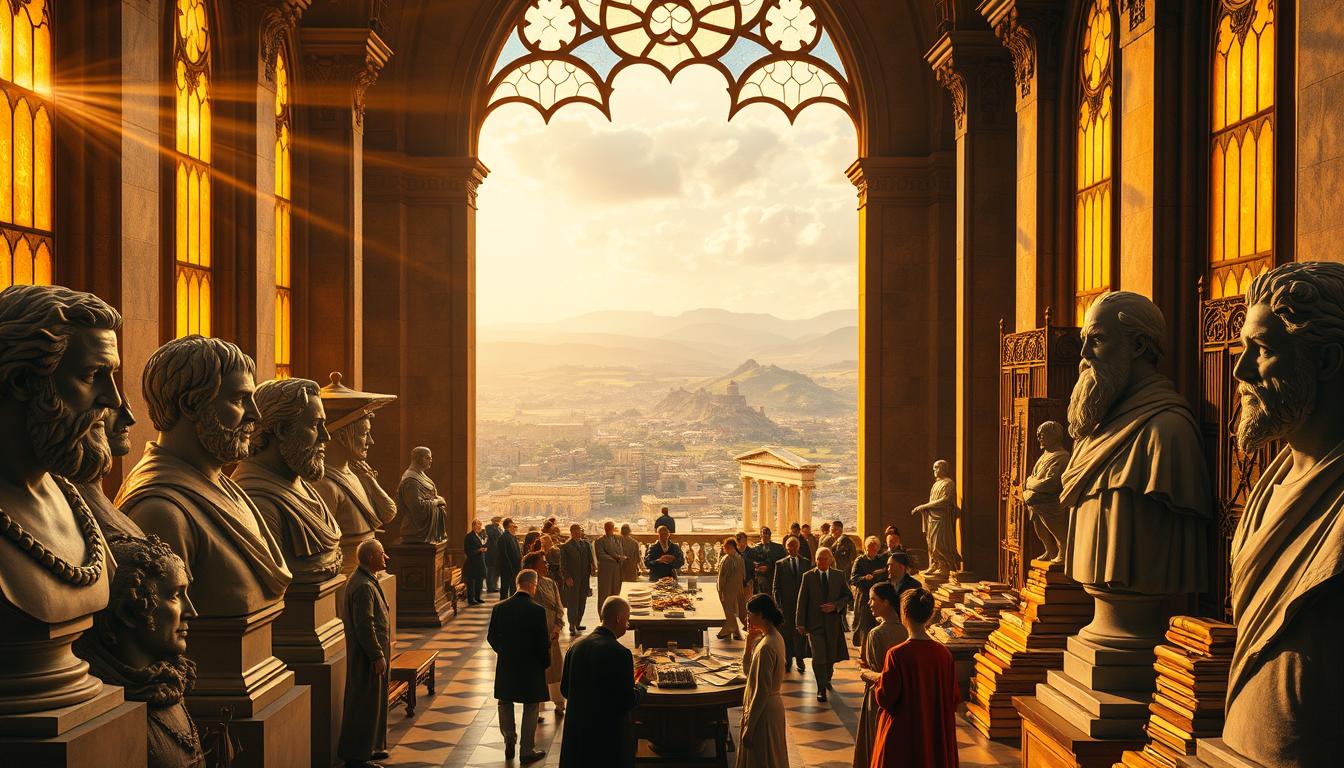
For over 2,500 years, influential thinkers have shaped our views on justice, ethics, and human ability. Aristotle and Confucius left behind teachings that are key to modern thought. Their ideas influence politics, science, and our daily choices.
John Locke and Simone de Beauvoir changed the world. Locke’s ideas on rights helped shape the U.S. Constitution. De Beauvoir’s The Second Sex changed feminism, showing philosophy’s power to spark change.
Today, their ideas continue to impact us. The University of the People follows Aristotle’s vision of accessible knowledge. Nietzsche’s call to question norms is at the heart of today’s debates. Discover how their ideas have shaped our world and continue to challenge us.
Introduction to Influential Philosophers
Philosophy started in ancient Greece, where thinkers pondered life’s big questions. They wondered about truth, morality, and life’s purpose. Socrates taught us to “know thyself,” while Confucius shared ethical codes that shaped societies.
So, why study philosophy? It helps us question our beliefs and think critically. Questions like “What is real?” or “How should we live?” are just as important today.
Philosophers like Plato founded the Academy of Athens, the first university. Aristotle and Avicenna made significant contributions to logic and medicine. Their work shows philosophy’s practical value.
The why study philosophy answer is its timeless relevance. It influences debates on ethics in AI and environmental justice. Kant’s Critique of Pure Reason and Nietzsche’s “God is dead” changed how we see knowledge and existence.
Philosophy’s importance of philosophy is seen in everyday decisions. It connects past wisdom to today’s challenges. Remember, philosophers throughout history have shaped humanity’s understanding of itself.
Ancient Philosophers Who Set the Stage
The journey of Western thought started in ancient Greece. Ancient Greek philosophers like Thales believed water was the universe’s foundation. By the 6th century BCE, Anaximander wrote the first philosophical text, On Nature. He proposed an infinite “apeiron” as the source of all matter.
Heraclitus said change—“everything flows”—was life’s constant. Parmenides argued change was an illusion. These pre-Socratics set the stage for Socrates Plato Aristotle to redefine human understanding.
Socrates, executed in 399 BCE, turned philosophy inward. He asked questions to expose moral truths. Plato’s dialogues, like The Republic, envisioned just societies ruled by philosopher-kings.
His student Aristotle shifted focus to empirical observation. He authored 31 surviving works on logic and biology. Across Asia, Eastern philosophical traditions flourished. Confucius emphasized ethics and hierarchy, while Lao Tzu’s Taoist ideas about harmony with nature shaped Chinese thought.
“The unexamined life is not worth living.”

These thinkers’ ideas are timeless. Aristotle’s logic underpins science; Confucius’ ethics shape governance. From Greece’s Agora to China’s courts, their debates on justice, knowledge, and existence remain alive.
The clash between Parmenides’ static reality and Heraclitus’ flux mirrors modern physics debates about time. Such legacies remind us: philosophy’s roots are alive in today’s questions.
Key Philosophers of the Middle Ages
Medieval thinkers like St. Augustine and Thomas Aquinas mixed faith with logic. They used Scholasticism, a method of structured debate, in universities like Paris and Oxford. They explored questions about God, free will, and reason’s role in understanding divine truth.
Islamic scholars Avicenna and Averroes influenced Western thought with their translations. Their views on Aristotle sparked debates among Christians and Jews. Maimonides, a Jewish philosopher, combined Aristotelian ideas with Torah study in his *Guide for the Perplexed*, later translated into Latin.
Thomas Aquinas merged Aristotle’s logic with Christian doctrine, creating systems studied today. His *Summa Theologica* tackled ethics, cosmology, and theology using Scholasticism. Anselm of Canterbury’s ontological argument for God’s existence combined faith and reason.
Translations of Greek and Arabic texts revived interest in logic and metaphysics. By the 13th century, universities became centers for debates on universals and divine illumination. This era’s legacy connects ancient thought to the Renaissance, showing the Middle Ages were not intellectually stagnant.
The Enlightenment and Rational Thought
The Enlightenment, from the late 1600s to early 1800s, changed the world by focusing on rational thinking. Thinkers like John Locke and Voltaire believed that human progress comes from reason and evidence. Their ideas about freedom and democracy influence laws and science today.

René Descartes started this change with his method of doubt. His famous saying “I think, therefor I am” showed the power of questioning. This idea became a base for scientific discovery, pushing for logic over tradition.
John Locke and individual rights were closely tied. His 1689 essay said all people are born free with rights to life, liberty, and property. These ideas inspired the U.S. Declaration of Independence and the French Revolution’s call for equality. Locke’s work challenged the idea that monarchs had a divine right, making them accountable to citizens.
Later, Immanuel Kant expanded these ideas, saying, “Dare to know!” He emphasized the importance of thinking for oneself. Denis Diderot’s Encyclopédie also spread knowledge, empowering people through education.
Scientific breakthroughs, like Isaac Newton’s laws of physics, showed nature’s order. This led to trust in human reason. The Enlightenment’s legacy is seen in classrooms, courts, and the quest for truth over authority.
19th Century Thinkers Who Challenged Norms
In the 19th century, big changes happened. Factories changed society, and revolutions shook Europe. Thinkers like Karl Marx and Friedrich Nietzsche rejected old ways. They wanted new ideas.
“The history of all hitherto existing society is the history of class struggles,” declared Karl Marx in *The Communist Manifesto*. He said workers and capitalists were in a fight for control.
Friedrich Nietzsche questioned old beliefs. He believed in the “will to power,” urging people to live life fully. This idea influenced many, including Søren Kierkegaard, who believed in making your own choices.
Existentialist thinkers like Kierkegaard and Nietzsche didn’t give easy answers. Marx’s ideas about wealth inequality started big movements. Nietzsche’s ideas changed psychology and art. Their work shows philosophy reflects society’s struggles.
The Rise of Modern Philosophy
In the 20th century, philosophers faced big challenges like world wars and new technology. 20th century philosophers split into two main groups: analytical philosophy and continental thought. Analytical philosophy, based on logic and language, grew in English-speaking countries.
Thinkers like Ludwig Wittgenstein and Bertrand Russell focused on meaning and truth. They aimed to make arguments clear. Their work helped create modern logic and ethics.

On the other hand, continental traditions like phenomenology and existentialism looked into human experience. Edmund Husserl’s phenomenology studied consciousness. Existentialists, like Jean-Paul Sartre, wondered about the meaning of existence.
These ideas questioned our beliefs about freedom and meaning in a broken world.
Thomas Kuhn’s 1962 book The Structure of Scientific Revolutions changed how we see progress. He said science moves in “paradigm shifts,” not just steady growth. This idea was like how 20th century thinkers challenged old ways—whether through existentialism’s focus on choice or analytical philosophy’s precision.
From Wittgenstein’s language games to Sartre’s radical freedom, these movements asked: How do we understand reality? Their debates continue to shape discussions on truth, ethics, and human purpose in our fast-changing world.
Influential Women in Philosophy
Women philosophers in history have shaped big debates on ethics and society. Yet, many are overlooked. Hypatia of Alexandria and Mary Wollstonecraft were ahead of their time.
Wollstonecraft’s 1792 book, A Vindication of the Rights of Woman, pushed for women’s education. This laid the groundwork for feminist philosophy. Simone de Beauvoir, despite obstacles, reshaped existentialism with her 1949 book, The Second Sex. She said, “One is not born, but becomes, a woman.”
“Feminism is for everyone.” — Simone de Beauvoir
Female philosophers have made significant contributions over centuries. Margaret Cavendish wrote on natural philosophy in the 1600s. Sor Juana Inés de la Cruz fought for women’s education in colonial Mexico.
Today, Martha Nussbaum argues that democracy needs compassion, not just economics. Hannah Arendt’s work on totalitarianism saw a huge increase in interest after 2016. This shows her ideas are timeless.
From Hildegard von Bingen’s medieval theology to bell hooks’ critiques of race and gender, these thinkers have broadened philosophy. Their wisdom reminds us that all voices matter, past and present. As feminist philosophy grows, it keeps breaking down barriers, ensuring no contributions are forgotten.
Contemporary Philosophers Making an Impact
Today’s philosophers deal with big issues like AI ethics and climate change. Contemporary philosophical thought connects old questions with today’s problems. It shapes talks on tech’s place in society and fairness in the environment.

Peter Singer’s ideas on utilitarianism start big debates on global poverty. His book The Life You Can Save caused protests, pushing for action in our digital world. Now, philosophy and technology meet in AI ethics, with thinkers like David Chalmers looking into AI consciousness.
Judith Butler changed how we see gender with Gender Trouble, showing identity is a performance. At the same time, environmental philosophy leads in climate talks. Martha Nussbaum and Amartya Sen’s work on capability ethics has shaped UN policies, linking ethics to environmental crises.
Slavoj Žižek criticizes capitalism’s hold on culture. Cornel West mixes Marxism with activism, appearing on TV to talk about race and democracy. Their ideas drive movements online and offline, showing philosophy’s impact in tech-driven societies.
From bioethics to social justice, these thinkers adapt philosophy to today’s challenges. Their work keeps ancient wisdom relevant in a world of algorithms and urgent climate issues.
Philosophy’s Influence on Other Fields
Philosophy in science helps us understand new discoveries. Thomas Kuhn’s The Structure of Scientific Revolutions changed how we see progress. He showed science moves in big leaps, not just small steps. This idea is a big topic in science today.
Business ethics use old ideas to solve new problems. From Aristotle’s teachings to today’s business rules, fairness is key. Companies use these ideas to deal with issues like AI and privacy.
AI ethics is a new area where philosophy plays a big role. It asks big questions about AI’s impact on society. Projects like the “Philosopher’s Web” show how old ideas lead to new tech.
Stephen Hawking said philosophy is essential to science. His words show how big questions drive new discoveries. This proves science and philosophy are closely linked.
Avicenna’s Kitāb al-shifāʾ mixed Islamic beliefs with Greek ideas, shaping medicine for ages. Confucius’ teachings also influenced law and education. Philosophy touches many areas, from science to business, showing its timeless value.
Conclusion: The Lasting Legacy of Philosophy
For over 2,500 years, philosophy has given us ways to understand the world. It helps us tackle big questions like ethics and existence, which are just as important today. From Thales’ early questions to Socrates’ dialogues, these ideas have shaped today’s debates on AI ethics and social justice.
Philosophy is more than just books. It influences our decisions in law, tech, and personal life. It teaches us to think critically, like Anaximander did by moving from myths to logic. Ancient wisdom helps us make sense of today’s complex issues, whether in ethics or technology.
Philosophy is a conversation that started in ancient Greece and continues today. From Aristotle’s logic to today’s climate ethics, it evolves with new challenges. By exploring its ideas, we learn to live thoughtfully. Its legacy shows us that curiosity and reason are always relevant in our changing world.