





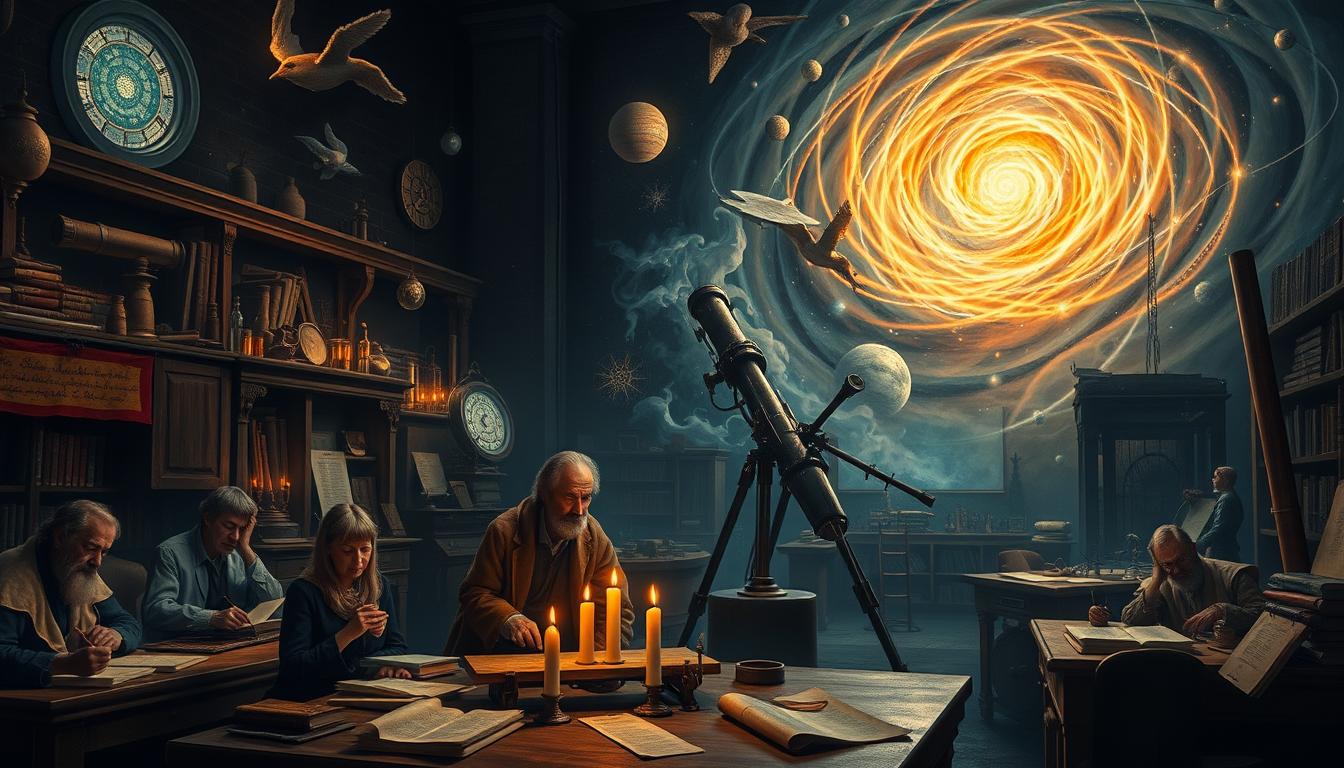
The Scientific Revolution changed how we see the world. It happened from the 16th to the 17th century. Scientific pioneers like Copernicus and Galileo challenged old beliefs. They started the foundation of modern science.
Their work in astronomy, physics, and math paved the way for today’s innovations.
Institutions like the Royal Society of London (1662) and Paris’s Académie des Sciences (1666) made science a team effort. Kepler mapped planets, and Galileo showed Earth isn’t at the center of the universe. Their work, like Copernicus’s heliocentric theory in 1543, laid the groundwork for modern astronomy.
Francis Bacon’s 1620 Novum Organum focused on evidence, moving science from philosophy to experiments. By 1687, Isaac Newton’s Principia combined math and observation. This change from old beliefs to testable ideas shows how people who shaped modern science created the basis for all scientific fields today.
The Importance of the Scientific Method
Francis Bacon changed how we learn. He moved from old ways to new ones. His scientific method development made science rely on facts, not just guesses.
His book Novum Organum from 1620 showed how to test and collect data. This was a big step forward.
“True philosophy is the offspring of physics,” Bacon wrote, underscoring experimentation’s role in uncovering natural laws.

Before Bacon, people followed Aristotle’s logic. Bacon’s method needed real-world evidence. This made testing and experiments key.
Galileo’s work with telescopes is a great example. Bacon’s ideas led to many discoveries. His experimental method made sure results could be checked again.
Now, science uses Bacon’s ideas with peer review and strict testing. This has led to many advances, like vaccines and space travel. Bacon’s work makes science always improve and correct itself.
Pioneers of Modern Physics
Galileo Galilei changed experimental physics with his telescope discoveries. In 1610, he saw the Moon’s craters and Jupiter’s moons. This proved Aristotle wrong about the heavens.
Galileo also studied falling objects and inclined planes. He showed that motion can be mathematically predicted. His work on Venus’ phases supported Copernicus’ sun-centered universe.
Isaac Newton built on Galileo’s work. His 1687 Principia Mathematica explained the laws of motion and universal gravitation. Newton’s first law says objects keep moving unless a force stops them.
His gravity formulas explained how planets move and why oceans have tides. These discoveries made physics a science based on numbers, not just ideas.
Revolutionizing Chemistry
Robert Boyle changed science by making alchemy more scientific. He showed that pressure and volume of gases are linked—Boyle’s Law. His 1661 book *The Sceptical Chymist* also rejected old ideas about elements. This move marked the start of chemistry based on evidence.

“Nature’s book is written in mathematical language,” Boyle wrote, stressing the importance of precision.
Boyle believed in chemical elements as the basic parts of matter. He encouraged scientists to test their theories through experiments. His work helped start the Royal Society, where he promoted teamwork.
Today, his ideas guide scientists in labs all over the world. They focus on facts and evidence, just as Boyle did.
Major Contributions from Biology
Early biologists moved biology from theory to practical research. They started studying anatomy by dissecting animals, but then Andreas Vesalius dissected humans. This showed the real anatomy of humans, challenging old texts.

Microscopy opened up new worlds. Antonie van Leeuwenhoek saw cells and microbes with his lenses. Later, better tools let scientists study tiny organisms closely. This changed anatomy studies into exact sciences.
In the 1700s, biological taxonomy began to take shape. Carl Linnaus created a system with two-part names for each species. His Systema Naturae listed over 12,000 species, making a universal system we use today.
These pioneers built biology’s base. Their work—dissection, microscopy, and taxonomy—changed biology from guesses to science. Their efforts support today’s genetics, ecology, and medicine, showing biology’s growth from philosophy to science.
Pioneers in Mathematics
Early mathematicians like Euclid and Archimedes set the stage for mathematical language and key principles. Euclid’s Elements organized geometry, while Archimedes worked on calculus-like ideas long before it was officially developed. Their work helped us grasp natural patterns.

Rene Descartes changed the game by combining algebra and geometry in analytical geometry. His coordinate system made it easier to work with shapes and equations. Isaac Newton and Gottfried Leibniz then developed calculus, a tool for mathematical physics that helps us understand motion and change.
Newton used calculus to explain gravity in his Principia Mathematica. Leonhard Euler and others built on this, creating systems we use today. Their work made math a universal mathematical language for science. Innovations like Euler’s equations and Leibniz’s binary system are key in modern computing and engineering.
These pioneers showed that math is more than just numbers. It’s the blueprint for understanding our world.
The Rise of Medicine and Health Sciences
Early medical science saw a big change as it moved from old beliefs to real study. Discoveries like human dissections replaced old theories. Pioneers like Andreas Vesalius showed the truth about the heart and nerves. This led to medicine based on facts.
In the 19th century, Ignaz Semmelweis made doctors wash hands to lower childbed fever deaths. His work was hard to accept but saved many lives. Florence Nightingale also made hospitals cleaner during the Crimean War, cutting death rates by half.
Medical history has many key moments. Louis Pasteur’s anthrax vaccine in 1881 saved 24 sheep out of 25. Joseph Lister started using antiseptics in surgery, and Alexander Fleming found penicillin in 1928. Today, we have CRISPR and cancer treatments thanks to these early steps.
Today, medical science keeps advancing. The Human Genome Project helped make treatments for each person. Drones now bring vaccines to hard-to-reach places. From ancient tools to mRNA vaccines, we’ve made huge progress in saving lives with science.
The Influencers of Technology
Early inventors turned curiosity into real scientific instruments that changed how we see the world. Tools like the mercury barometer and vacuum pump were key scientific tools. They let us explore nature’s secrets.
These mechanical devices, from Hooke’s microscopes to Pascal’s calculator, were both useful and groundbreaking. They showed how to mix practicality with discovery.
In labs and workshops, innovation grew. Torricelli’s barometer showed us the air pressure, and Huygens’ pendulum clock made timekeeping better. These inventions paved the way for later discoveries like the steam engine.
Even simple tools, like Galileo’s telescopes, showed us the universe. They proved that scientific instruments can open new doors for us.
The printing press helped spread knowledge faster than ever before. Francis Bacon wanted science to improve our lives. His ideas led to tools like the steam digester, which inspired James Watt’s engine.
Robert Boyle’s work on air pumps showed how research can lead to real progress. His inventions were not just for the lab. They laid the groundwork for today’s tech, like computers and medical imaging.
From mechanical calculators to precise lenses, each scientific tool was a step forward. Today, our smartphones and AI owe a debt to these pioneers. Their work shows that curiosity and creation are key to innovation.
Impact of Social Sciences
Early social sciences started when thinkers applied science to studying human behavior. Thomas Hobbes, for example, used detailed analysis to understand governance. This work helped shape political science.
During the Enlightenment, people moved from philosophy to using evidence to learn. This change was inspired by the ideas of Descartes and the curiosity of the Renaissance.
Adam Smith began studying how wealth is distributed through real-world observations. Montesquieu linked laws to society’s structure. Anthropologists documented cultures during colonial times.
These efforts helped create modern fields like sociology and political science.
Today, social sciences tackle big issues. They help make public health policies during pandemics. They also work on solving climate change by studying human behavior.
The UK is a leader in this area. They use social science to improve education, fight inequality, and plan cities.
But, there are challenges. Marginalized groups are often underrepresented in these fields. Scholarships like UNCF’s help increase access. As the field grows 18% by 2030, it continues to apply Descartes’ logic to complex human systems.
The Legacy of Early Scientists
The scientific revolution changed how we see the world. It laid the groundwork for modern science. Pioneers like Copernicus and Newton’s work is key to today’s science.
Terms like “hypothesis” and “experiment” were introduced in the 1600s. They are the foundation of science. Peer review, born from the printing press, shapes how we validate discoveries today.
Breakthroughs by Darwin and Pasteur have led to major advances in medicine and biotechnology. The scientific revolution emphasized the power of evidence over old beliefs. Today, innovations like CRISPR and quantum computing build on these early ideas.
From Copernicus to today’s space missions, science is a continuous journey. Each generation answers old questions and raises new ones. Newton’s laws and Mendeleev’s periodic table are used in labs around the world.
The true legacy of the scientific revolution is in every lab, hospital, and classroom. Your curiosity could be the next step in this long chain of discovery.