







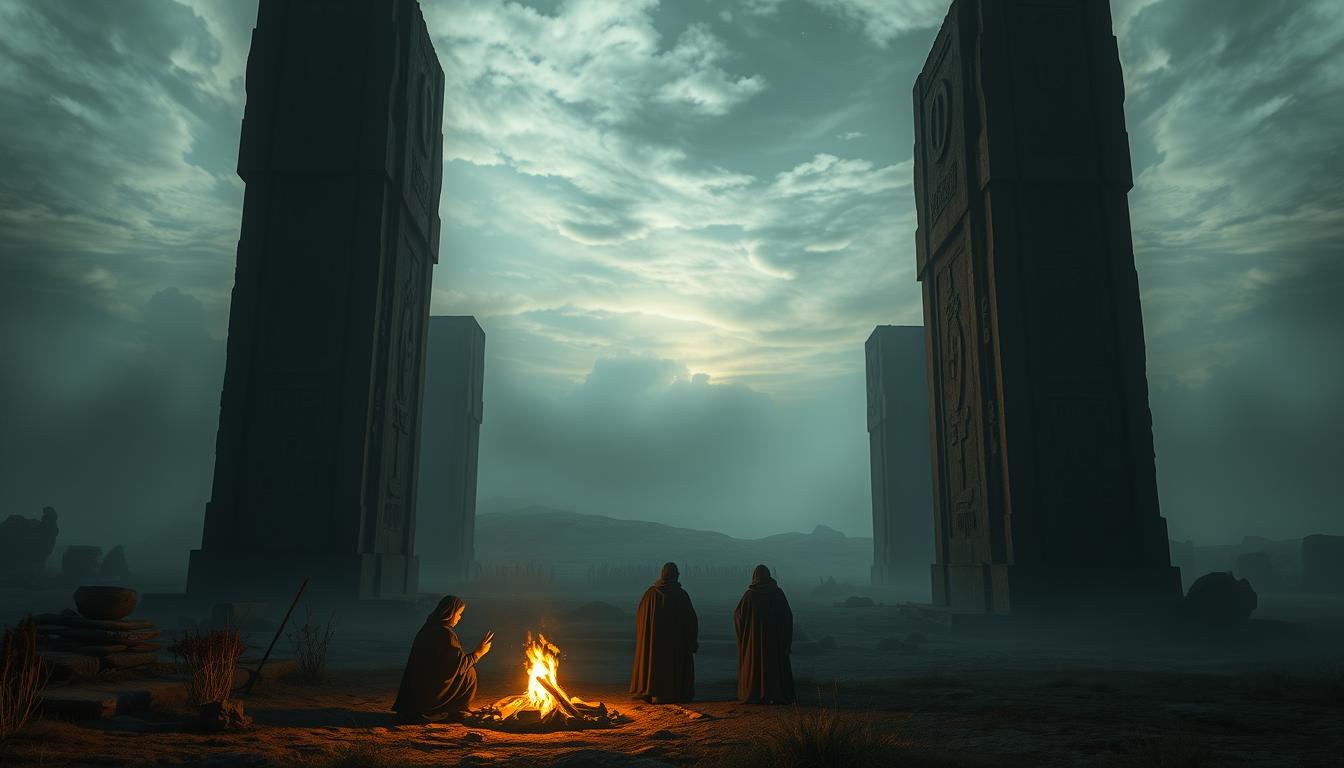
Myths were the first guides for humans. Every society used myths to explain the world. These stories answered big questions about origins and morality. Carl Jung saw myths as key for the human mind, bringing order to chaos.
Ancient mythology shaped how people saw everything. It explained storms and social roles.
Long before writing, myths spread through stories. The epic of Beowulf, from eighth-century Northumbria, wasn’t written until the 1000s. King Arthur’s first mention was in a sixth-century Welsh poem.
These tales bridged mystery and understanding. They turned unknown forces into stories we can relate to.
Myths weren’t just stories; they formed social contracts. They taught right from wrong, like the Torah for Jewish identity or Rome’s founding myth. Even today, echoes of these tales live in works like Tolkien’s dragons or Game of Thrones’ direwolves.
Through them, primitive mythology links past to present. It proves their lasting myth significance.
Understanding Folklore and Natural Phenomena
Folklore traditions have long given natural explanations for the world’s mysteries. Before modern science, people believed weather was controlled by gods. Thunderstorms were seen as battles between gods like Thor and Zeus.
Seasons were tied to stories of Persephone’s journey between Hades and the earth. This linked folklore science to the cycles of nature.
Across cultures, similar natural events sparked similar stories. Japanese myths tell of islands formed by Izanagi and Izanami’s spear. Tibetan lore says earthquakes come from a giant frog’s movements.
These stories show our shared curiosity about the world. Weather myths, like the Taino’s “hurricane” named after their god Juracán, personified storms as divine will.
The rainbow is a trail left by Iris, the divine messenger.
Myths also taught important lessons. The Maori story of Maui capturing the sun with his grandmother’s hair teaches patience and teamwork. Hawaiian tales about Pele’s volcanic eruptions warn of nature’s power.
These stories were more than just tales. They were early attempts to understand the world. Folklore science mapped the cosmos through shared human experiences. It showed ancient explanations were not just fantasies but survival tools, connecting communities to their world.
The Role of Myths in Ancient Societies
Myths were more than just stories. They were the blueprints for ancient social structures. Stories like the Epic of Gilgamesh helped unite tribes by mixing human flaws with divine lessons. Through rituals and shared tales, communities built their cultural identity, ensuring everyone knew their place.
Imagine a village where every member knew their people’s origins. The Xia Dynasty’s myths linked leaders to gods, justifying their power. This wasn’t just storytelling—it was the glue that held society together.

Moral mythology guided behavior without written laws. Greek gods like Zeus taught humility by punishing arrogance. Native American trickster tales, like Coyote’s, mixed humor with lessons on adaptability.
These stories became moral roadmaps, guiding decisions long before formal ethics existed. Over 75% of ancient cultures used myths to explain creation, solidifying their beliefs in cosmic order. Even today, their echoes influence how we view heroism or justice.
Myths are “maps of the mind,” revealing how ancient peoples navigated existence’s chaos.
Myths also helped with survival. Navajo healing rituals use creation stories to restore balance, showing myths as living traditions. From Egypt’s pyramids to Norse sagas, these tales were blueprints for identity, morality, and unity. They prove that the past’s stories continue to shape our understanding of ourselves.
Earth and Sky: Mythical Explanations for Weather
Ancient cultures believed in storm gods to explain the skies. Norse myths showed Thor’s chariot racing through clouds. Greek tales linked seasons to Demeter’s sadness over her daughter’s loss. These weather mythology stories helped people understand nature’s cycles.
“The earth’s tears are Tlaloc’s mercy,” said Aztec priests, tying rain to the gods’ moods. Such rain myths guided farming cycles, ensuring crops grew when deities were pleased.
Stories of sky deities like Zeus or Indra (who rode elephants during monsoons) connected storms to divine will. Japanese myths blamed earthquakes on Namazu, a giant catfish restrained by Kashima—a metaphor for nature’s untamed forces. These tales turned chaos into meaning, teaching respect for the environment’s power.
Seasonal shifts became journeys in seasonal folklore. Demeter’s reunion with Persephone marked spring’s return, while Inuit stories saw auroras as ancestral spirits. Myths like these blended survival and spirituality, showing how weather was never just rain or wind—it was a conversation between earth and sky.
Today, these stories live on in festivals and art, proving how weather mythology shaped human imagination. From thunder’s roar to winter’s frost, ancient myths remind us that the skies have always been storytellers.
Animal Tales: Explaining Wildlife Behavior
Animal folklore has long shaped our understanding of the natural world. It tells us why bats fly at night and why ravens are jet-black. Animal origin myths mix observation with imagination. These creature stories often explain traits through divine acts or moral lessons.
For example, some Native American tales say the coyote’s slyness comes from trickster stories teaching balance. Norse myths describe Odin’s ravens, Huginn and Muninn, as symbols of thought and memory.

Wildlife mythology also reflects cultural values. Ancient Egyptians saw cats as sacred and punished those who harmed them. Greek myths cast eagles as Zeus’s messengers, linking them to power.
These narratives encoded survival knowledge. Observing spider web during eclipses or birds falling silent at totality became part of animal behavior explanations. Modern science echoes these ancient insights. During the 2017 solar eclipse, fireflies flashed at totality, mirroring how Indigenous peoples once tied such events to spiritual forces.
“Myths are humanity’s first field guides,” noted ecologist Aldo Leopold, highlighting how stories preserved ecological wisdom.
Today, over 30 U.S. wildlife refuges in the 2024 eclipse path continue this tradition. They host events where visitors explore both science and animal folklore. By blending curiosity with respect, these tales remind us that animals are not just creatures—but they are our culture and natural heritage alive.
Creation Myths and Earthly Existence
Creation stories and origin myths show interesting similarities across cultures. Over 100 different world creation folklore traditions exist. These include ancient Mesopotamia’s cosmological myths and Indigenous Australian stories.
Many myths start with chaos—a void or watery abyss. Then, divine forces bring order. For example, the biblical Genesis account is similar to Sumerian tales of Enki and Egyptian stories of Atum.
Divine speech creating reality is a common theme. The Hindu Rigveda says speech was the first element of the universe. Norse myths also talk about Odin’s words creating existence.
Mircea Eliade found five mythological types: creation from nothing, earth-diver, emergence, dismemberment, and primordial unity. These types show common patterns. But, each culture adds its own twist: Inuit myths tie origins to ice and sea, while Amazonian stories focus on tropical ecosystems.
These myths also shaped societies. Many myths define sacred time and space. For example, the Navajo Emergence story talks about four sacred mountains. The Popol Vuh’s Maya creation story makes maize the basis of life.
Over 90% of these myths feature a supreme being. This shows humanity’s ongoing search for meaning. Even modern science’s Big Bang theory echoes ancient myths, showing myths help us understand the world.
Fire, Stone, and Lightning: Symbolism Explored
Myth symbols like fire, stone, and lightning show how ancient cultures saw nature’s power. Fire myths, like the Chinese tale of Fuxi, show fire as a gift and a tool. Fuxi, a Chinese god, taught humans to control flames for cooking and crafting.
This elemental symbolism shows how much humans rely on fire for survival and progress.

Stone symbolism also shaped beliefs. Monuments like Stonehenge or megalithic temples show stone’s duality. It’s strong yet can be shaped.
Lightning myths, like Zeus’s thunderbolts or the Etruscan lightning gods, linked storms to divine power. Even today, cultures like the Etruscans see lightning strikes as messages, tracking their paths and effects.
“Lightning’s strike is a language from the gods,” Roman poet Lucan wrote, highlighting its ritual importance. Though science explains lightning’s 4x solar temperature, its mythic power endures. Over 31.5 million strikes yearly remind us how these elements bridged the sacred and the practical.
Fire’s controlled use, seen in early hearths 350,000 years ago, and lightning’s raw energy show how myths encoded survival wisdom. These symbols connect ancient and modern views of nature’s forces.
The Influence of Folklore on Scientific Understanding
Myths shaped early proto-science by seeing natural events as divine actions. The Moken people survived the 2004 tsunami thanks to Katoy Oken, a legend. This shows how myths started explaining the unexplained, leading to systematic inquiry.
Pre-Socratic thinkers like Thales questioned myths but used them too. They mixed stories with observation, bridging scientific mythology and empirical methods. For example, alchemy turned into chemistry, and astrology became astronomy.
“The Histories of Herodotus blends myth with inquiry, showing how myths informed early historical scientific development.”
Modern science keeps mythic echoes. Terms like Atlas vertebrae or Jupiter show this. Even today, words like “hurricane” come from myths, showing myths shape science.
Disasters like earthquakes are explained through cultural stories. From Japan’s Namazu catfish to Greek Poseidon myths. These stories, though not “correct,” sparked curiosity and fueled discoveries. Science’s roots in myth remind us of our timeless curiosity and love for stories.
Folklore in Modern Contexts
Today’s stories are filled with modern mythology. Authors like J.K. Rowling and Neil Gaiman mix old myths with new tales. The Lord of the Rings uses Norse myths, while American Gods updates old gods for today’s America. This shows how myths evolve through creativity.
“Folklore is the unofficial culture of the people, shaping shared truths,” noted Richard Dorson in 1976. His words are true today, as urban legends like Slender Man spread online. They reflect our modern fears through folklore.
Urban legends today teach us lessons. Social media helps them spread, making digital spaces new places for stories. Shows like Game of Thrones mix myths with drama, using dragons and prophecies. Even tech companies, like Apple, use folklore in their logos.
Folklore has proven it can adapt. It’s not just kept alive but also changed. Storytellers blend old patterns with today’s issues, keeping these stories relevant. From TikTok to big movies, folklore reflects our hopes and fears.
The Global Tapestry of Folkloric Myths
Myths connect us through stories that blend local tales with universal truths. They show how similar stories, like floods or trickster heroes, appear worldwide. From ancient Mesopotamia to Indigenous Australia, these stories share patterns that go beyond borders.
These patterns suggest we all share common experiences, from birth to death. They reflect our fears of chaos and our desire for meaning.
Comparative mythology reveals striking similarities. Trickster figures like Loki, Anansi, and Coyote teach us through their antics. Flood myths, from China’s Gun-Yu to the Bible’s Noah story, share key elements despite cultural differences.
Even dying-and-rising gods, such as Osiris or Dionysus, symbolize our hopes for renewal. These myths point to common psychological needs and environmental influences in storytelling.
Why do these themes keep appearing? The hero’s journey is found in 75% of myths, reflecting our shared struggles and dreams. Psychological theories suggest archetypes like the hero or sage mirror our universal human experiences. Environmental factors, like rivers or deserts, also shape the meanings in these stories.
For example, water is a symbol of change in 45% of myths, reflecting its importance in our lives.
By studying these threads, we see myths as mirrors and bridges. They show that, despite cultural differences, we all share core fears, joys, and questions. This global tapestry of stories is a map of what it means to be human, told in countless voices.
The Connection Between Myth and Nature
Nature-based myths were deeply woven into daily life. Indigenous wisdom taught respect for ecosystems through stories. These stories made forests, rivers, and animals sacred.
Many cultures banned hunting certain species or protected groves. They used taboos to conserve resources. These practices ensured sustainability long before modern ecology.
“Myths explain matters in ‘the science of a pre-scientific age,” noted scholars Maria Leach and Jerome Fried. This ecological folklore often encoded practical lessons—like seasonal farming cycles or medicinal plant uses—into memorable tales.

Australian Aboriginal Dreamtime stories describe land formations as creations of ancestral spirits. They guide stewardship of specific regions. Native American myths warned against overhunting by framing animals as kin.
These narratives, passed orally, embedded ecological balance into cultural norms. Even Greek myths like Helios’ cattle symbolizing yearly cycles or Selene’s daughters marking time reveal how nature-based myths tracked seasonal rhythms.
Today, indigenous nature wisdom offers lessons for climate challenges. By blending mythological insights with science, societies can rediscover sustainable practices long cherished in ecological folklore.
Challenges in Preserving Folklore
Folklore preservation is facing big challenges as modern life changes traditions. Oral traditions are fading as people spend more time on screens and in school. Without effort, we risk losing our cultural heritage.
“Myths are humanity’s first textbooks,” noted anthropologist Alan Dundes, yet today’s classrooms rarely teach them.
Colonial histories erased many stories, and global media is pushing out local tales. Languages without writing systems are losing their stories when elders pass away. Even recordings can fail if they don’t respect community wishes.
But, there’s hope. Digital tools like audio recordings and apps are helping. Indigenous groups, like the Maori in New Zealand, are leading the way in digitizing their stories.
Preserving folklore is more than just saving old stories. It’s about teaching young people to share tales in new ways. Ethnographers are working with communities to keep traditions alive. This balance ensures myths continue to guide us, not just as relics.
Future Directions for Folklore Research
Folklore studies are evolving, mixing old tales with new tools. Scholars use psychology, anthropology, and computer science to study how stories influence us. Digital tools like network analysis uncover patterns in myths worldwide.
For example, Berezkin’s catalog shows 2,564 motifs across 958 societies. It shows how myths change based on their environment. Earthquake motifs, for instance, are 35% more common near seismic zones.
Narrative research looks at folklore’s role in our global world. Online platforms let stories travel, but there are debates about cultural respect. Video games and VR bring ancient themes to life, showing the importance of comparative folklore.
Flood myths, found in 83% of cultures, show how universal struggles inspire stories. This highlights folklore’s power to connect us across time.
Modern research must find a balance between tradition and innovation. Berezkin’s collection of 75 language families shows myths reflect our shared experiences. Studying how ancient stories helped communities adapt can guide us today.
Folklore connects science with emotion, bridging the Four Functions of Folklore. Researchers use statistics to understand how environment influences stories. Yet, folklore studies also value cultural empathy.
By combining data analysis with cultural understanding, future research can help us navigate change. It preserves the wisdom of past generations.