







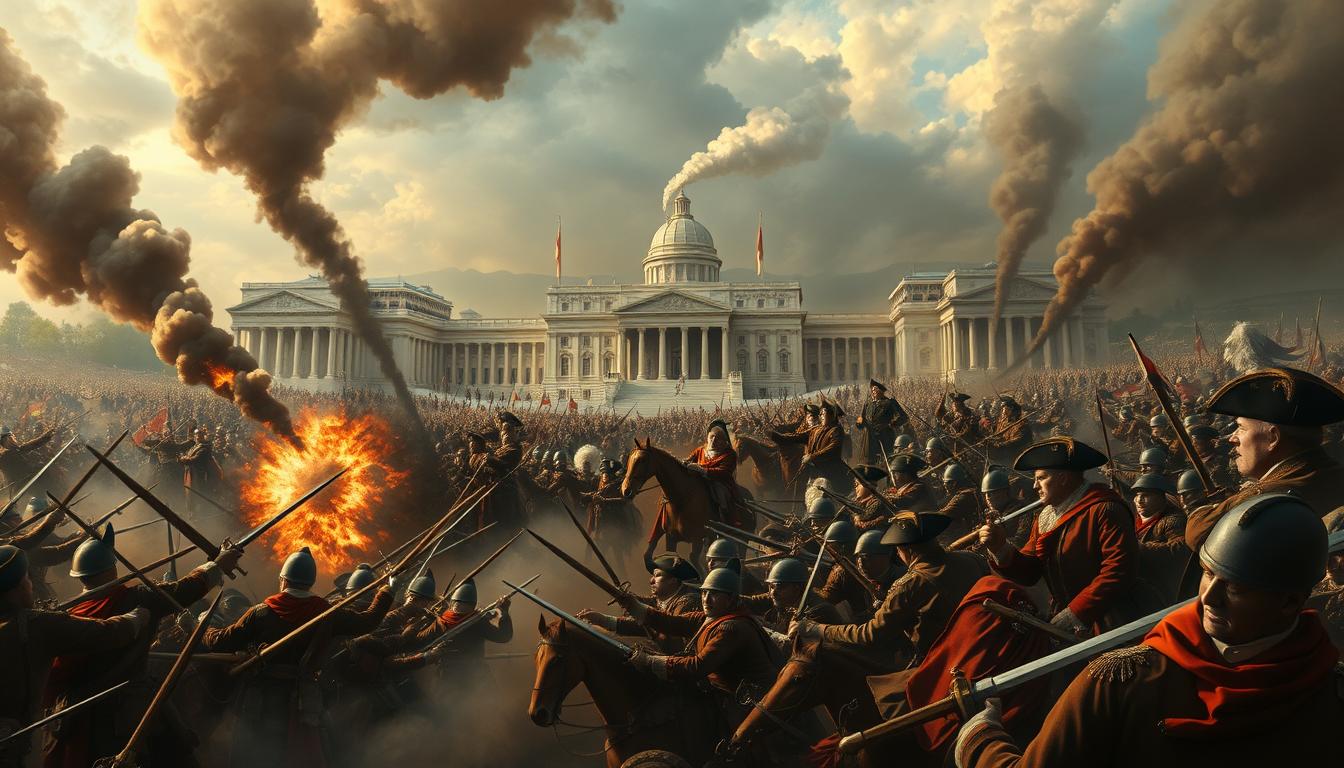
History’s most influential rivalries and pivotal conflicts have left lasting impacts on human progress. They have reshaped nations and driven scientific breakthroughs. For example, Ignaz Semmelweis fought to prove handwashing saves lives.
Thomas Edison’s rivalry with Nikola Tesla changed the future of electricity. These famous rivalries in history show how competition drives change.
Art and politics have always been connected. Paintings, literature, and monuments have both supported and challenged political power. The debate over Darwin’s theories and the Cold War’s space race are examples.
This article looks at how these moments have shaped our world. From ancient empires to modern science, we see how opposition has fueled human achievement.
Understanding Famous Rivalries in History
Rivalries have shaped human history, leading to both destruction and progress. From ancient empires to today’s politics, historical competition between famous adversaries shows us ambition and tension. These conflicts often start over resources, ideas, or pride, changing societies forever.
The 900-year fight between England and France is a prime example of enemy relationships. Their battles, from the Norman Conquest to the Napoleonic Wars, were about land and ideas. The Punic Wars between Rome and Carthage also lasted for decades, showing rivalry’s long-lasting impact.
“Great talent often has a free spirit that attracts the irritation of officialdom, creating natural tension between creative forces and established power.”
This tension sparks innovation. The Cold War between the US and USSR is a great example. It pushed technology and culture forward. Even today, old rivalries like Scotland’s 2014 vote show how competition drives us to grow.
Rivalries show how human ambition and resistance to authority lead to change. By understanding these patterns, we can see why wars, art, and science breakthroughs happen. This knowledge helps us grasp the motivations behind these achievements.
Political Rivalries That Changed Nations
Political conflicts have reshaped borders and laws. Alexander Hamilton and Thomas Jefferson’s leadership battles over federal power set America’s course. Their debates on banking and states’ rights forged a lasting legacy.
Across oceans, Churchill’s rise after Neville Chamberlain’s failures marked a turning point. As Karl von Clausewitz wrote, “War is the continuation of politics by other means.” Churchill’s clash with Hitler turned WWII into a fight for survival.

Cold War government rivalries between superpowers defined modern politics. The Truman Doctrine and NATO emerged from fear of Soviet expansion. Gladstone and Disraeli, bitter political enemies, fueled Britain’s reforms.
Their mutual disdain pushed parliamentary changes. Even local rebellions, like Spain’s comuneros revolt, revealed how power struggles could topple empires. Kennedy and Khrushchev’s Cuban Missile Crisis brought the world to the brink, proving leadership battles could decide survival.
These rivalries, though destructive, spurred progress. Churchill’s wartime decisions saved Europe. Kennedy’s diplomacy avoided nuclear war. While power struggles often bring pain, they also drive innovation—from civil rights advancements to global alliances. History’s turning points often stem from the fierce, fiery clashes between those seeking control.
Artistic Rivalries That Ignited Creativity
“Art can be used to organize people around a certain goal.”
From the Renaissance to today, creative rivalries have pushed artists to explore new styles. Michelangelo and Raphael, under Pope Julius II, competed to fill Vatican spaces. Their works, like Michelangelo’s Sistine Chapel ceiling, challenged Raphael’s frescoes, driving both to excel.
Picasso and Matisse battled for decades, shaping modern art. Their styles, Cubism and Fauvism, were showcased by dealer Pierre Loeb. Their artistic feuds led to Matisse’s vibrant colors and Picasso’s broken forms.
In music, artist conflicts also shaped history. Rimsky-Korsakov’s folk-inspired works clashed with Tchaikovsky’s Western-influenced pieces. This reflected Russia’s cultural identity struggles. Hemingway and Faulkner’s literary feud also pushed the boundaries of storytelling.
Degas’ return of Manet’s portrait, with a note about plums, showed the tension between artistic visions. These personal battles led to incredible works of art. As one source said, “A free spirit’s talent often sparks conflict.” This competition has always driven creativity forward.
Scientific Rivalries That Pushed Boundaries

The battle between Nikola Tesla and Thomas Edison over electricity is a prime example ofscientific competition. Their fight over AC vs DC power systems changed how we distribute energy. It showed thatinnovation battlescan change whole industries.
The rivalry between Watson, Crick, and Rosalind Franklin in DNA discovery sped up big advances in biology. Their work, despite ethical debates over who should get credit, shows howresearch rivalriescan speed up progress.
The debates between Einstein and Bohr over quantum mechanics are another example ofacademic feudsshaping science. Einstein said, “Imagination is more important than knowledge,” but their disagreements made science stronger. Newton and Hooke’s fight over gravity also pushed physics forward, despite their personal issues.
“Science is built up with facts, as a house is with stones.” — Henri Poincaré
The Manhattan Project and the space race were globalinnovation battles that turned wartime efforts into major achievements. The rivalry between Salk and Sabin over the polio vaccine in the 1950s also drove medical progress. Thesediscovery conflictsshow the good and bad sides of rivalry: pushing boundaries but also raising ethical questions.
From Copernicus challenging old views to today’s AI debates, science often grows from disagreements. Whileresearch rivalriescan lead to bitterness, they’ve also driven many discoveries. This shows that competition can be a powerful force for finding new things.
Wars Fueled by Rivalries
Many historic wars started with small disagreements but grew into big conflicts. The Punic Wars between Rome and Carthage began over trade. The medieval War of the Oaken Bucket started when soldiers took a water bucket, killing thousands. These stories show how small issues can lead to big wars.

Conflicts were caused by many things, like wanting land or control over trade. The Franco-Prussian War (1870) was over a crown prince’s claim, leading France to lose Alsace-Lorraine. This shows how wanting more land and power can lead to war.
Even small issues, like the Fashoda Crisis of 1898, could almost start a war. This crisis was between France and Britain over Sudan, showing how pride can lead to conflict.
“Alexander’s campaigns pursued divine power and recognition, not cultural conflict.”
By 1900, European powers were racing to get colonies, fearing economic decline. Germany’s 1900 War Council feared Russia’s growth, pushing for war. These fears, along with nationalism, led to World War I.
Rivalries have shaped military competitions and war motivations for centuries. Greed, pride, and power struggles have turned small disputes into big wars. These conflicts leave lasting impacts on today’s world.
Cultural Rivalries That Defined Eras
Cultural conflicts have long been catalysts for transformation. The clash between traditionalists and modernists in the early 20th century reshaped art and society. Edgar Degas and Édouard Manet, once collaborators, became rivals after Manet destroyed a portrait Degas painted of him. This cultural movement clash highlighted tensions between personal loyalty and artistic vision.

“The arts take on political as well as social dimensions, becoming a force of change,” as seen in the rivalry between Vincent van Gogh and Paul Gauguin. Their cultural battles over artistic style led to a volatile partnership, ending in 1888 with a knife incident. Yet their rivalry spurred innovations in post-impressionism.
Cultural movements like the Cold War’s societal competition between East and West turned art into propaganda. Picasso and Matisse’s decades-long tension pushed modern art forward. Even today, social rivalries like hip-hop vs. rock debates reflect ongoing cultural conflicts. These clashes, though divisive, often spark creativity. From Renaissance feuds to modern identity struggles, such rivalries remind us that progress often emerges from friction.
Sports Rivalries That Captivated Fans
Sports competitions often turn into heated rivalries that go beyond the field. Teams like the Red Sox and Yankees, or Barcelona and Real Madrid, show decades of team conflicts. These rivalries create electric atmospheres where every game feels like a battle for identity.
The UConn Huskies and Tennessee Lady Vols have battled in women’s basketball for over 30 years. UConn leads 17-9 overall. In 2004, the Red Sox’s historic comeback against the Yankees in the ALCS showed how rivalries fuel unforgettable moments.
Federer and Nadal’s 39 clashes, including the 2008 Wimbledon final, became legends of tennis rivalry. International rivalries like India vs. Pakistan in cricket or Australia vs. England’s Ashes series carry political undertones. They turn sports into a stage for national pride.
The Harvard-Yale football game, played for 147 years, mixes academic rivalry with team conflicts. It draws thousands annually. Modern rivalries like the Lakers-Celtics NBA Finals showdowns or the Super Bowl clashes between the Patriots and Falcons highlight how rivalries drive innovation and passion.
These contests remind us that competition isn’t just about trophies—it’s about uniting fans through shared emotions.
Technological Rivalries in Business
Business competition has long fueled tech rivalries that reshape industries. Apple and Microsoft’s clash began with a 1997 $150M partnership. This partnership later sparked a battle over market dominance. Their rivalry pushed innovations like the Mac vs. Windows, proving how corporate enemies can drive progress.
“The world doesn’t need another Dell or HP,” Steve Jobs declared, capturing Apple’s push for uniqueness. This mindset fueled the iconic “I’m a Mac” ads, turning personal rivalry into marketing strategy.
Market battles between AMD and Intel span decades. After a $1.4B EU fine, AMD’s Ryzen chips now challenge Intel’s dominance. In smartphones, Samsung’s sales lead contrasts Apple’s profit focus, each aiming to outdo the other’s features and pricing.
Innovation contests thrive in space too. Elon Musk’s SpaceX and Jeff Bezos’ Blue Origin race to lower launch costs. Salesforce’s clashes with Oracle over cloud tech highlight how corporate clashes drive better tools. Even social media saw Facebook and Apple clash over privacy, with Apple’s 2018 ad-tracking update causing tension.
Amazon’s 2005 Diapers.com acquisition and GitHub’s $7.5B Microsoft buyout show how tech rivalries spark growth. While corporate feuds can create friction, they often lead to faster, cheaper tech for all. These clashes prove that competition, even messy, can spark breakthroughs.
The Role of Rivalries in History Education
History teaching aims to balance facts with empathy. Modern methods encourage students to see how rivalries shaped societies. This helps learners understand the complexity of human conflict.
“Art can serve as a way of preserving important historical events,” highlighting how paintings or literature from rival groups can reveal hidden perspectives. A painting of the Dutch-Kongo alliance against Portugal, for instance, shows how partnerships formed during global rivalries.
Conflict education should go beyond simple “good vs. bad” stories. Traditional tales often oversimplify past disputes. Today, classrooms dive into the motives behind conflicts like the Dutch-Kongo alliance or the Mughal-Persian wars.
Teachers use primary sources to show the trade, power, and cultural clashes in rivalries like the 150-year Portuguese-Kongo rivalry. This approach helps students see patterns in human behavior.
Schools also explore the 43-year Panda Game rivalry in sports. This shows how competition can inspire innovation without demonizing opponents.
Now, educators focus on understanding over judgment. Lessons on the 18th-century British-French colonial rivalry include both economic motives and cultural clashes. By studying these dynamics, students gain tools to analyze current conflicts with nuance.
Conclusion: The Impact of Rivalries on Society
Rivalries have a big impact on our world, mixing creativity and division. They shape sports, science, and more. For example, rivalries like Arsenal vs. Spurs show how small differences can spark big competitions.
Even in sports, rivalries like Bayern Munich vs. Dortmund or Red Sox vs. Yankees can be beneficial. They push for innovation but must be handled carefully to avoid negative effects.
History teaches us that rivalry’s outcomes depend on our choices. Babe Ruth’s move to the Yankees sparked a rivalry that grew baseball. Bayern Munich’s loan to Dortmund in 2004 shows how to keep rivalry alive without exploiting it.
Plato warned about human desires and rivalry’s double nature. But, the Great Peace of Montréal and Jackie Robinson’s impact on baseball show rivalry can unite. By learning from these examples, we can use rivalry to progress, not just divide.
So, the question is: Do we let rivalry fuel division, or use it to build together? Our answer will shape our future.