







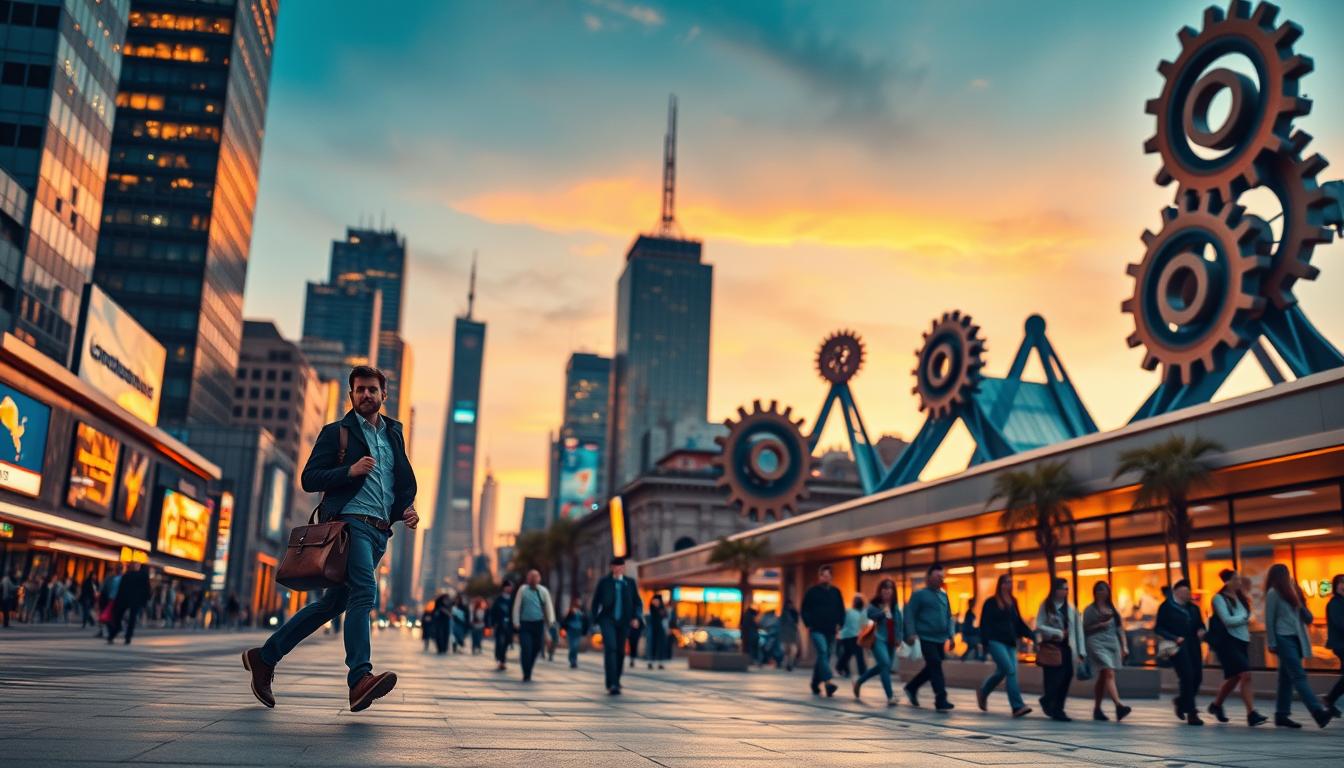
Leaders like Reed Hastings (Netflix) and Jeff Bezos (Amazon) show how vision can change economies. They didn’t just grow big companies. They changed how we watch movies, shop, and use technology.
These innovators took big risks and kept innovating. They created jobs and changed industries. Their work shows the power of entrepreneurship.
Small and medium businesses create two-thirds of new jobs worldwide. MIT alumni have started 30,200 active companies. These companies employ 4.6 million people and make $1.9 trillion a year.
Entrepreneurship boosts productivity and creativity, even with high failure rates. Half of new businesses close in five years. Survival depends on being adaptable and having access to resources like money and advice.
This article looks at how pioneers like MIT’s 25% alumni founders change markets. Their stories show the mix of determination, teamwork, and timing that turns ideas into economic powerhouses.
Introduction to Economic Innovators
Economic change-makers are entrepreneurs who change how businesses work. Their business transformation efforts affect many industries. Reed Hastings, for example, changed Netflix from mailing DVDs to a digital streaming giant. This move changed how people watch movies and TV shows.
Jeff Bezos took Amazon from selling books to a global online store. Both leaders were ready to change their own success. Economist Joseph Schumpeter said, “Entrepreneurship shakes up the market.”
These innovators think big and focus on customers. Schumpeter’s “creative destruction” theory shows how new industries replace old ones. Today, 85% of economic growth comes from innovation, showing it drives progress. Even small changes, like Tesla’s move to affordable EVs, show how adapting leads to success.
VC-backed companies like Apple and Alphabet now lead the world. They influence more than just money; they shape our culture. When companies invest in research and development, they create jobs and new technologies. For example, renewable energy now powers 26% of global electricity, changing energy markets.
Economic change-makers don’t just follow trends; they make them. Their lasting impact comes from turning risks into chances for success. They show that lasting success means always being ready to change.
The Tech Revolution and its Giants
From humble beginnings in garages, tech entrepreneurs like Bill Gates and Steve Jobs changed the world. Microsoft and Apple set new standards with their software and hardware. Today, business innovators like Elon Musk keep pushing the limits—Tesla and SpaceX are examples.
Jeff Bezos turned Amazon into a $386 billion retail giant by 2020. Netflix’s Reed Hastings changed entertainment with 200 million subscribers. These leaders didn’t just build companies; they created entire ecosystems.

Mark Zuckerberg’s Facebook, with 2.8 billion users, changed how we communicate. Each giant’s story shows innovation drives markets. Their success changes our daily lives, from shopping to work.
These leaders show tech is more than gadgets—it’s changing economies. As their companies grow, so do debates on regulation and the future of work. The next chapter? Merging AI and space exploration, pushing boundaries once again.
The Rise of Social Entrepreneurship
Social entrepreneurship is changing how we do business, showing that profit and purpose can go hand in hand. People like Reshma Saujani, founder of Girls Who Code, are leading the way. She has helped over 200,000 girls get into tech, closing the gender gap and preparing the next generation of leaders.
“Everyone has the right to shape technology, not just use it.” — Reshma Saujani
Today, entrepreneurs are mixing profit with making a difference. Companies like TOMS and B Corps like Patagonia are showing how it can be done. They use their profits to help others, creating a cycle of giving back.
But, there are hurdles. Getting funding is 30% harder for social businesses. Despite this, the impact investing world is growing by 20% each year. This shows that investors are starting to care more about making a difference.
Customers want brands that do good, with 85% preferring them. This is pushing big companies to focus on their social missions. Social businesses are also helping fight poverty, reducing it by 25% in the areas they work in. Yet, it’s hard to measure how much of a difference they’re making, with 60% of entrepreneurs finding it tough.
Change-makers are redefining what success means. With the right policies, like tax breaks for social businesses, they could grow by 15%. Blended finance models, which mix grants and investments, aim to help them get the funding they need. As younger people focus more on values than just making money, social entrepreneurship is becoming a key to a fairer world.
The Financial Mavericks
Financial pioneers like Mark Cuban have changed how money moves and grows today. He started with tech ventures and sold MicroSolutions in 1990 for $6 million. Then, he made a big splash with Broadcast.com’s 1999 sale to Yahoo for $5.7 billion.
His journey didn’t end there. He bought the Dallas Mavericks in 2000 for $285 million. By 2023, he turned them into a $3.3 billion empire. This shows his talent for finding opportunities others miss.

As a business innovator, Cuban pushed boundaries in finance with crypto and blockchain. He’s invested in hundreds of startups on Shark Tank. His Mark Cuban Foundation also offers free AI bootcamps for underprivileged students.
Even when faced with challenges, like a SEC case he won, Cuban stays strong. His work covers tech, sports, and giving back, showing innovation thrives where risk meets vision.
Now, his investments in crypto and fintech reflect a broader trend: making finance accessible to everyone. The 32 companies in “Mavericks at Work” have created thousands of jobs and billions in wealth. This proves financial pioneers are not just about making money; they build communities.
Cuban’s journey, from coding in basements to supporting Ethereum, shows one person can change society’s view of money.
Women Leading the Charge in Business
Women in business are changing the game. Leaders like Mary Barra at General Motors and Ursula Burns, Xerox’s first Black female CEO, bring new ideas. They show how different views lead to innovation.
Gender parity in entrepreneurship could add $12 trillion to global GDP by 2025.
U.S. women-owned businesses have added 1.4 million jobs and made $579.6 billion. They now make nearly $1.8 trillion a year, employing 10 million people. Studies show companies with women in charge make 15% more profit and gain 45% more market share.
But, there are challenges. Women-led startups get only 3% of venture capital, but they grow faster. Arianna Huffington sold The Huffington Post for $315 million, and Rihanna’s Clara Lionel Foundation gave $7.1 million in 2023. These stories show how purpose can lead to big impact.
Women are making their mark in tech and media. Their success is not just about fairness—it’s about adding trillions to the economy. As more women lead, they change markets and redefine success.
Sustainable Entrepreneurs Making Waves
Sustainable business leaders are changing the game by combining profit with planet care. People like Yvon Chouinard of Patagonia and Elon Musk of Tesla show that making money and saving the planet can go hand in hand. Their work, from eco-friendly clothes to electric cars, shows how business innovators can change industries and fight climate change.
“The business of business should be to be of benefit to society.” — Yvon Chouinard, Patagonia
Patagonia’s repair programs and Tesla’s electric cars are leading the way. Brands like WUKA and Flexible Energy are also making waves. They’re turning old things into new ones, like YANA Active’s recycled clothes and Huskaloo’s coconut cat litter.
Winning awards like the Sustainability Entrepreneur of the Year Award shows who’s leading the charge. Lottie Hawkins of Earthly Biochar is helping farmers with her soil products. These innovators show that being green can spark new ideas. Even small companies like thelittleloop and Healthy Nibbles are changing the game.
These business innovators are pushing for big changes. The Ellen MacArthur Foundation and the Billion Oyster Project are making a difference. They’re showing how businesses can help the planet. And with 73% of consumers wanting sustainable brands, the demand is growing.
These leaders are showing that being green is not a cost, but a key to success. As more sustainable business leaders join, they’ll shape a better future for all of us.
Defining Success in the Gig Economy
Leaders in the gig economy, like John Zimmer of Lyft, changed how we work. They created platforms that connect freelancers with jobs. This has helped cities grow, with new businesses popping up after Uber or Lyft arrive.
Working in the gig economy means managing your money well. Gig economy leaders at TaskRabbit and Upwork help workers juggle different jobs. But, it’s tough: only 16% save for retirement, and 78% handle taxes themselves.
As more people join the gig economy, leaders must focus on benefits and stability. Businesses use freelancers to save money, but quality can suffer without clear communication. Sites like Fiverr and Freelancer help, but respect and honesty are key to success.
The Influence of Globalization on Entrepreneurship
Global business leaders like Jack Ma and Huateng “Pony” Ma have changed the game. Jack Ma’s Alibaba connected Chinese suppliers with buyers worldwide, leading to huge growth. Tencent’s Pony Ma introduced mobile payments that beat Western tech, showing how new markets can shake up old ones.
Now, startups aim to be global from the start. Thanks to cheaper shipping and communication, distance is no longer a barrier. Over 70% of entrepreneurs say international partnerships are key to growth. But, 55% face challenges like cultural misunderstandings when expanding.

Technology keeps pushing innovation forward. Telecom costs have plummeted, making real-time teamwork easier. Companies with diverse teams see creativity jump by 35%. But, dealing with different laws and rules is a big challenge.
Globalization’s effects are not the same everywhere. Countries with less money get to join global markets but struggle with funding. Yet, Alibaba and Tencent show that going global can make a small success into a global giant. As the world gets smaller, new innovators will lead by embracing both chances and changes.
The Role of Startups in Economic Growth
Startup founders, like the team behind YouTube, show how pivoting can lead to big changes. What started as a dating site became a global video platform. This shows how quick and adaptable business innovators can be.
Today, startups are a big part of the U.S. economy, making up over 15% of it. They create two-thirds of all new jobs every year. Even though more than half fail within five years, the ones that make it help the economy grow through new ideas.
Groups like Y Combinator and Techstars help startups grow. Companies like Stripe and Cruise Automation got bigger thanks to these programs. Events like AcceleratorCON, starting on September 29, help founders get the help they need to grow.
But, there are also challenges. Fewer people start businesses now than in the past. Only 1–2% of workers start their own businesses each year. Too many rules can stop new ideas, but the right ones can help them grow.
Even when startups fail, they learn and get stronger. This is true for innovators like Airbnb’s founders. Every success story comes from many attempts and partnerships.
Startup founders are all about creativity. They turn risks into chances to change industries. Their work has a big impact on the economy, showing that innovation is key to growth.
The Future of Entrepreneurship
Entrepreneurship is changing fast. The future of entrepreneurship will rely on tech like AI, blockchain, and quantum computing. Startups are using these tools to tackle big issues like climate change, healthcare, and financial inclusion.
Today’s economic change-makers are creating decentralized networks and virtual worlds in the metaverse. They are changing how businesses work.

“The next decade will reward those who blend tech innovation with purpose,” says a 2023 report by the Global Entrepreneurship Monitor.
Recent data shows over 545,000 new businesses launched monthly in 2020. This shows resilience. Many founders now focus on community-owned models, like DAOs, where everyone makes decisions together.
These changes aren’t just about making money. They aim to solve big problems like climate crises or inequality.
Entrepreneurs today face challenges like skill gaps and ethical dilemmas. Yet, 80% reinvest in local communities, boosting jobs and public services. With AI automating routine tasks, future innovators must focus on creativity and ethics.
The economic change-makers of tomorrow will need to balance innovation with responsibility. They must ensure growth benefits everyone.
As tech speeds up change, the future of entrepreneurship depends on adaptability. From biotech breakthroughs to sustainable ventures, the next wave of founders will redefine what’s possible. Their choices today will shape economies for generations.
Conclusion: The Lasting Legacy of Economic Change-makers
Economic change-makers like Netflix and YouTube show that being adaptable is key. They moved from DVDs to streaming and from dating sites to global platforms. This shows how innovation keeps businesses alive.
Successful entrepreneurs focus on their customers, challenge the status quo, and are willing to disrupt their own success. This approach is essential for growth.
Schumpeter’s idea of creative destruction explains how new industries replace old ones. This boosts innovation. Entrepreneurs like those behind Airbnb or Tesla have reshaped economies by creating jobs and increasing GNP.
Even small firms can lead in innovation, as Acs and Audretsch pointed out. This shows that size doesn’t matter when it comes to making an impact.
From the 1970s to today, more people have become self-employed in OECD nations. This shows entrepreneurship’s role in keeping economies strong. These change-makers grow businesses and change how societies work and live.
They also help create policies that support startups and inspire future generations to tackle big challenges. This includes climate tech and healthcare.
The Fortune 500’s shrinking employment share shows that sticking to old ways doesn’t work. The future is for those who embrace Schumpeter’s vision of innovation driving progress. Every entrepreneur plays a part in the ongoing story of economic change.
The question is not just how they changed markets. It’s how you’ll shape the next wave of business transformation.