





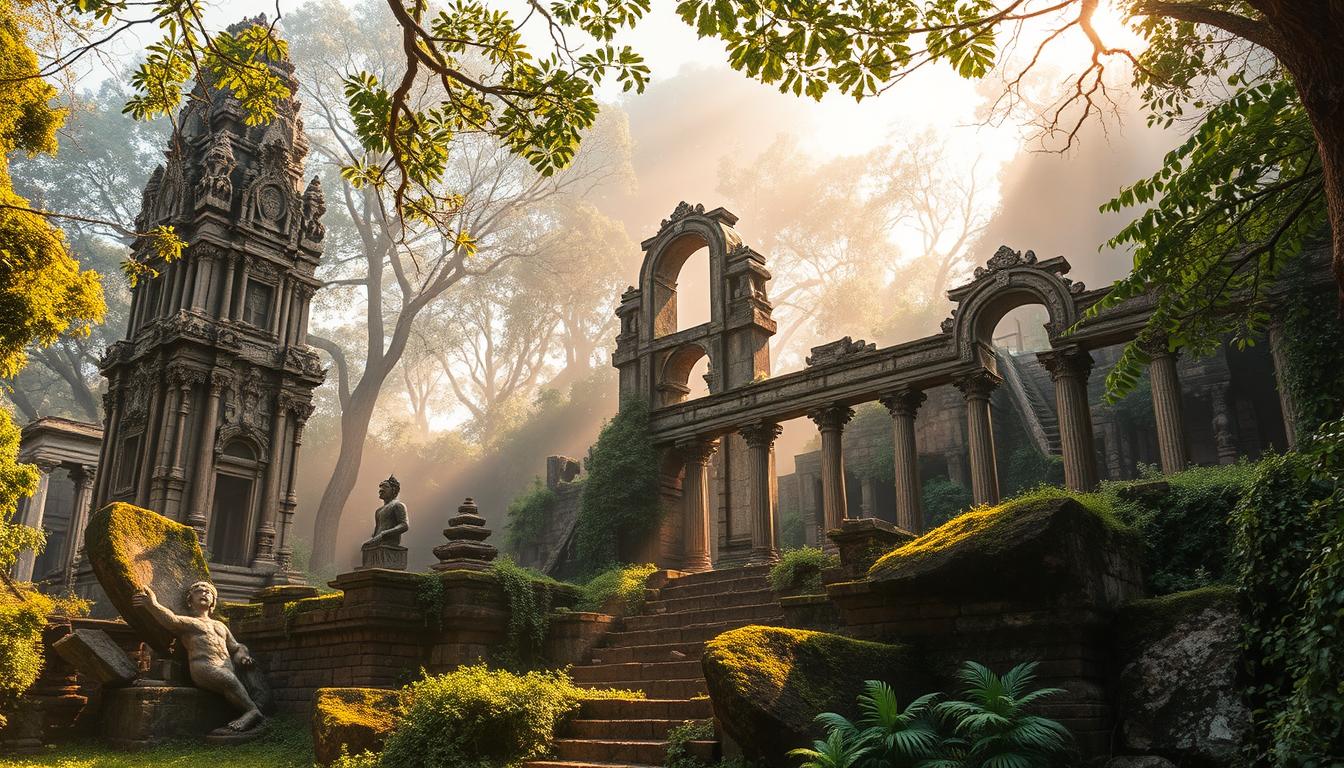
Lost civilizations like the Maya, Indus Valley, and Easter Island remind us of ancient societies that vanished. They left behind vanished cultures and historical mysteries. These ancient societies built towering pyramids and complex cities, shaping history before disappearing.
The Maya empire once covered Guatemala and Mexico, building cities that collapsed by 900 CE. The Indus Valley civilization, home to five million people, vanished 3,000 years ago. It was rediscovered by archaeologists in 1920.
Easter Island’s moai statues symbolize a culture that peaked at 15,000 people but dwindled to just 100 by the 1800s. Cahokia, a bustling North American city with 40,000 residents, also vanished. It left behind Monks Mound’s massive earthen structure.
These stories of ancient societies, from Khmer’s Angkor to Viking Greenland, ask why thriving civilizations collapsed. This article explores how environmental shifts, wars, and resource scarcity turned once-great cities into historical mysteries waiting to be solved.
The Mystique of Legendary Lost Civilizations
For centuries, mysterious ancient cultures have been on the fringes of our understanding. Places like the Nazca Lines and Easter Island’s Moai statues are lost to history. They leave behind only stones and endless questions.
These enigmas, like the Indus Valley script or Puma Punku’s engineering, spark endless debates. The Sphinx’s weathering and Petra’s cliffside tombs offer hints of worlds beyond our reach.
What draws us to these mysteries? It’s the unknown that captivates us. The sudden disappearance of Teotihuacan’s people or Mohenjo-Daro’s advanced systems puzzles us. Even Stonehenge, aligned with solstices, hints at lost knowledge.
Every artifact, like an Olmec head or a Pompeii shard, connects us to the past. Yet, each discovery raises more questions. Why did advanced societies disappear? How did they build wonders like Sacsayhuamán’s stones? Our quest for answers continues, driven by curiosity and a sense of wonder.
The Maya Civilization: A Triumph of Culture
The Maya civilization was a key part of Mesoamerican culture. They built huge pyramids and complex cities in Mexico, Guatemala, Belize, and Honduras. Their Mayan ruins, like Chichén Itzá’s Pyramid of Kukulcán, show their engineering skills.
This pre-Columbian civilization was great at math, creating a zero-based number system. They also made a 365-day calendar that matched ancient astronomy observations.
Maya astronomers followed Venus and eclipses to plan rituals. They put this knowledge into temple designs. Their writing system recorded history on stelae, and cities like Tikal had plazas and palaces.
But, the Maya collapse around 900 CE left cities empty. Reasons include drought, war, and environmental problems.
Today, Maya descendants keep traditions alive with stories and festivals. From ancient temples to modern ceremonies, the Maya’s legacy connects past and present. Their science and artistry continue to amaze us, showing their culture’s lasting impact.
The Aztec Empire: Glory and Fall
The Aztec Empire was a powerful Mesoamerican empire in central Mexico. By 1519, its capital Tenochtitlan was a wonder, with canals and temples. It was home to nearly 300,000 people.
Aztec society was advanced, with floating farms called chinampas and aqueducts for water. Their Tenochtitlan markets had 50,000 traders. They also had a 52-year calendar system.
In 1519, Spanish conquistador Hernán Cortés arrived. Aztec ruler Montezuma welcomed him at first. But things turned bad fast.
Diseases like smallpox spread, and Cortés made enemies of the Aztecs. In 1521, after a year, the Spanish took Cuauhtémoc. This ended the Aztec Empire.
The empire once covered 80,000 square miles, taking tribute from others. But it fell due to internal fights and outside threats. Tenochtitlan’s fall shows how advanced societies can quickly disappear under pressure.
The Indus Valley Civilization: Advanced Urban Planning
In ancient India, the Harappan civilization was a marvel. Cities like Mohenjo-Daro and Harappa had streets laid out in grids. They also had urban drainage systems that were ahead of their time.

The “Great Bath” in Mohenjo-Daro and its housing blocks show a focus on health and community. Standardized bricks and weights point to a centralized authority in trade and building. But the undeciphered script on seals and artifacts remains a mystery.
This civilization once had over 1,000 settlements and a population near five million. It declined, possibly due to river changes and drought. Today, Mohenjo-Daro is a UNESCO site, showing ancient India’s engineering skills and a puzzle waiting to be solved.
The Ancient Egyptians: More Than Just Pyramids
The Egyptian Old Kingdom, known as the “Age of the Pyramids,” was famous for its pyramid builders. They created wonders like the Great Pyramid of Khufu. But this era was more than just building.
Engineers and scribes made big strides in medicine, studied the stars, and created hieroglyphic writing. These achievements marked the pharaonic civilization, which flourished along the Nile for over 3,000 years.
The Nile Valley culture relied on the river’s floods for farming and religious rituals. When the Old Kingdom fell into civil war during the First Intermediate Period, Egypt showed its strength.
After the chaos, the Middle Kingdom brought back order, showing Egypt’s ability to adapt.
Hieroglyphic writing, uncovered by the Rosetta Stone, shows a mix of science and faith. The Egyptian Old Kingdom’s impact goes beyond pyramids. Their story teaches us about rising, falling, and reviving civilizations.
The Inca Empire: Masters of the Mountains
The Andean civilization of the Incas ruled the Andes Mountains for centuries. Their engineering marvels, like Machu Picchu, amaze modern architects. This stone citadel sits 7,000 feet high, built with 100-ton boulders that fit perfectly without mortar. 
Inca engineering turned harsh landscapes into fertile lands. The Qhapaq Ñan road network spanned 24,000 miles, connecting distant provinces. They built terraced farms and irrigation systems, feeding 12 million people with 3,000 potato varieties. Runners carried messages 150 miles a day, keeping control over 100+ languages across the empire.
The quipu system was key to their administration. It used colored, knotted strings to record taxes, harvests, and histories. This tool managed the empire without written language, showing their administrative brilliance. The capital Cusco’s gold-adorned temples showed their wealth until Spanish greed destroyed it.
When Francisco Pizarro captured Emperor Atahualpa in 1532, the Spanish conquest started. Small forces used civil war, disease, and gold hunger to their advantage. The empire fell in years, not decades, leaving ruins like Machu Picchu to puzzle future generations.
The Ancestral Puebloans: Cliff Dwellers of the Southwest
The Ancestral Puebloans, also known as the Anasazi culture, created amazing cliff dwellings in the Four Corners region. Their most famous sites, like those at Mesa Verde, are multiroom complexes in canyon walls. These ancient societies were experts at surviving in North America’s driest landscapes.
They farmed corn and hunted using advanced irrigation systems for centuries. But by the late 1200s, a long drought and deforestation caused a crisis. Tree-ring studies show a 30-year drought starting in 1276, destroying crops and leading to conflict.
By 1300, most communities had left their cliff homes. Today, descendants live in New Mexico and Arizona, keeping their traditions alive. The Mesa Verde ruins remind us of their ingenuity and adaptation, inspiring us even today.
The Minoan Civilization: Early European Culture
The Minoan civilization was a key part of Bronze Age Crete. They built the Knossos palace, a five-story wonder with advanced bathrooms and drainage. This palace, filled with Minoan art like dancing peacocks and leaping bulls, showed a society that thrived through Mediterranean trade.
Their ships carried Cretan ceramics to places like Egypt and Anatolia. They traded these goods for copper and gold.

The Thera eruption around 1600 BCE might have caused a series of disasters. Volcanic ash buried fields, tsunamis hit ports, and the economy collapsed. Artifacts like the Phaistos disc suggest a literate culture, but their Linear A script is a mystery.
Women played important roles in governance and religion, as seen in frescoes. This contrasts with later societies that were more patriarchal.
Even though the Minoans fell, their influence lasted. Bull motifs showed up in Greek mythology, and their trade networks helped the Mycenaeans rise. Today, archaeologists are fascinated by the remnants of their culture, from frescoes to seal stones, trying to understand their sudden decline.
Causes of Civilization Collapses
Historians and scientists find patterns in why societies fail. Environmental damage is often a key factor. For example, the Akkadian Empire was hit by a 300-year drought.
The Mediterranean saw a drought from 1250–1100 B.C. This pushed societies to their limits. The Maya faced crop failures due to climate change. The Anasazi left their homes because farming became impossible.
Running out of resources also led to decline. Deforestation and soil loss left Easter Island vulnerable. The Roman Empire’s need for more land and resources led to its downfall.
Warfare played a role too. Spanish invasions hurt the Maya, while the Sea Peoples’ raids weakened Egypt. Economic troubles, like Rome’s currency problems, made things worse.
Systems failing together was a common theme. Earthquakes and droughts in the Mediterranean around 1200 B.C. hurt trade and economies. Social issues, like religious divisions, also weakened societies.
Research by Luke Kemp shows civilizations last about 340 years before they decline. No single reason explains why societies collapse. Instead, it’s a mix of climate changes, wars, and ecological damage that pushes them over the edge.
Today, we face similar problems. Environmental strain, resource competition, and inequality are all challenges. Ancient collapses teach us the importance of being resilient and addressing crises as a whole.
The Modern Search for Lost Civilizations
Today, archaeological methods are changing how we see history. Satellites and LiDAR scans uncover ruins hidden by jungles and oceans. In Ecuador, satellite archaeology found a 2,500-year-old city covering 115 square miles.
Its layout shows a society with thousands of people. This challenges old ideas about ancient populations.

Underwater excavations are also making new discoveries. Places like Pavlopetri, Greece, a 5,000-year-old sunken town, are being explored. Mahabalipuram’s temples were found again after a tsunami.
These underwater excavations show how rising seas destroyed cities. DNA analysis of ancient remains also sheds light on migration paths. It shows how different cultures shared technologies and genes.
Efforts to preserve our heritage are underway. 3D scanning helps document fragile sites before they disappear due to climate change. UNESCO works with technology to protect sites threatened by looting or development.
Questions about who owns ancient artifacts arise. Should modern communities help guide excavations?
From LiDAR mapping in the Amazon to DNA labs, science is revealing secrets. Every scan, dive, and sample brings us closer to understanding past societies. It also warns us about our own future.
Lasting Legacies of Lost Civilizations
Though these ancient societies vanished, their cultural inheritance lives on in modern life. The Maya’s precise astronomical calculations shaped early calendars. Egyptian innovations like the 365-day solar calendar guide timekeeping today.
Rome’s concrete mixtures inspire modern sustainable building research. Inca stonework techniques influence earthquake-resistant designs. These architectural influences are seen in today’s engineering.
Technological innovations from the past solve present challenges. Indus Valley urban planning informs contemporary city design. Their grid layouts and drainage systems are studied today.
The Sumerians’ cuneiform writing laid foundations for global literacy. Their base-60 math system remains in our time measurements. Inca’s road networks across South America mirror today’s infrastructure projects.
Historical continuity connects ancient wisdom to modern solutions. Mayan agricultural methods are studied for climate-resilient farming. Egyptian mummification techniques inspired early medical practices.
Mesopotamian legal codes like Hammurabi’s influenced modern justice systems. These ancient achievements remind us to balance progress with environmental stewardship. A lesson from civilizations that collapsed due to ecological neglect or war.
From Machu Picchu’s terraces to the Roman aqueducts, these societies’ ideas endure. Their stories urge us to learn from their triumphs and mistakes. As we face today’s challenges, their innovations and warnings offer a blueprint for resilience.
Our own legacy, like theirs, will one day be part of humanity’s ongoing journey. A reminder that cultural inheritance is a bridge between past and future.