


Artists who change their craft often start by questioning the usual. Bisa Butler turned quilts into powerful portraits, bringing life to old photos with harmful labels. Her use of vibrant fabrics, like the Speed Bird pattern, tells stories of wealth and African American heritage.
But it’s not just about textiles. Tetsuya Noda mixed Japanese woodblock art with modern prints, capturing everyday life in his Diary series. Artists like Linda Lighton and Richard Hunt also use new materials to share bold ideas.
Sean Scully and Mira Nakashima show that even old mediums can change. Scully’s bold stripes reflect German Expressionism, while Mira’s woodwork celebrates natural flaws. They don’t just make art; they change how we see it.
From embroidery’s rise as a tool for social messages to ceramics exploring gender, their work changes cultural talks. This article looks at how these pioneers turned challenges into lasting legacies. It shows that changing art is as much about bravery as it is about creativity.
Introduction to Artistic Transformation
Artistic innovation starts when creators break free from the norm and change their craft. Bisa Butler’s quilted portraits, for example, turned quilting into a powerful storytelling medium. Her work shows how transformative creators push the limits of what art can do.
Tetsuya Noda combines ancient Japanese woodblock techniques with modern printing. This mix of old and new shows the bold thinking of boundary-pushing artists. They ask: What happens when tradition meets innovation?
Looking at the process behind the art is key. The 2011 book Extra/Ordinary: Craft and Contemporary Art talks about this. It says that art’s value now includes the journey, not just the end result.
Transformative creators focus on the effort, not just the fame. Conceptual art from the 1970s shows this shift. Today’s artists balance innovation with making a difference.
These transformative creators show that true innovation is not just about skill. It’s about rethinking the rules. Their work sets the stage for the groundbreaking artists we’ll explore next.
Historical Overview of Artistic Evolution
Art has evolved over centuries, thanks to pioneering creatives who dared to be different. During the Renaissance, artists like Leonardo da Vinci and Michelangelo merged science and art. Their work paved the way for future breakthroughs, showing that creativity knows no bounds.

The Industrial Revolution shook things up. Photography came along, shaking the foundations of painting. William Morris led the Arts & Crafts Movement, rejecting mass production. His Kelmscott Press brought back handcrafted books, and Morris & Company’s textiles combined beauty with practicality.
Revolutionary art techniques like hand-block printing in the 1870s kept the art of making things by hand alive during this time of change.
“Have nothing in your houses that you do not know to be useful, or believe to be beautiful.”
In the 20th century, Modernism brought big changes. Artists like Picasso and Duchamp changed what art was all about. Cubism and readymades broke the rules, showing that art can always evolve.
Movements like Art Nouveau and Wiener Werkstätte spread the Movement’s influence worldwide.
But there’s more to the story than just the big names. Newcomb College Pottery (Tulane University) and female designers like Mary Colter made significant contributions. Their work, like handcrafted ceramics, showed the diversity of artistic progress. Even ancient civilizations like the Achaemenid Empire and Egypt left behind monumental structures that show the enduring power of human creativity.
Groundbreaking Visual Artists of the 21st Century
Modern art spaces are alive with medium-defying artists pushing the limits of creativity. Ai Weiwei’s 2010 Sunflower Seeds installation, with 100 million hand-painted porcelain seeds, turned a simple craft into a powerful statement. It spoke to the contrast between mass production and individuality.
Bisa Butler uses quilting to tell the stories of African American histories. Her “Kool-Aid colors” and global textile choices turn quilting into innovative artists’ storytelling. Each stitch brings cultural heritage to life in today’s art, showing that fabric can carry as much emotion as paint.
Technology is driving today’s art revolution. Over 75% of artists now use digital tools, blending code and AI with physical mediums. Refik Anadol creates immersive VR installations from data, while TeamLab crafts groundbreaking artists’ interactive light and space environments. Even painters like Julie Mehretu are expanding painting’s possibilities by layering digital scans with hand-painted textures.
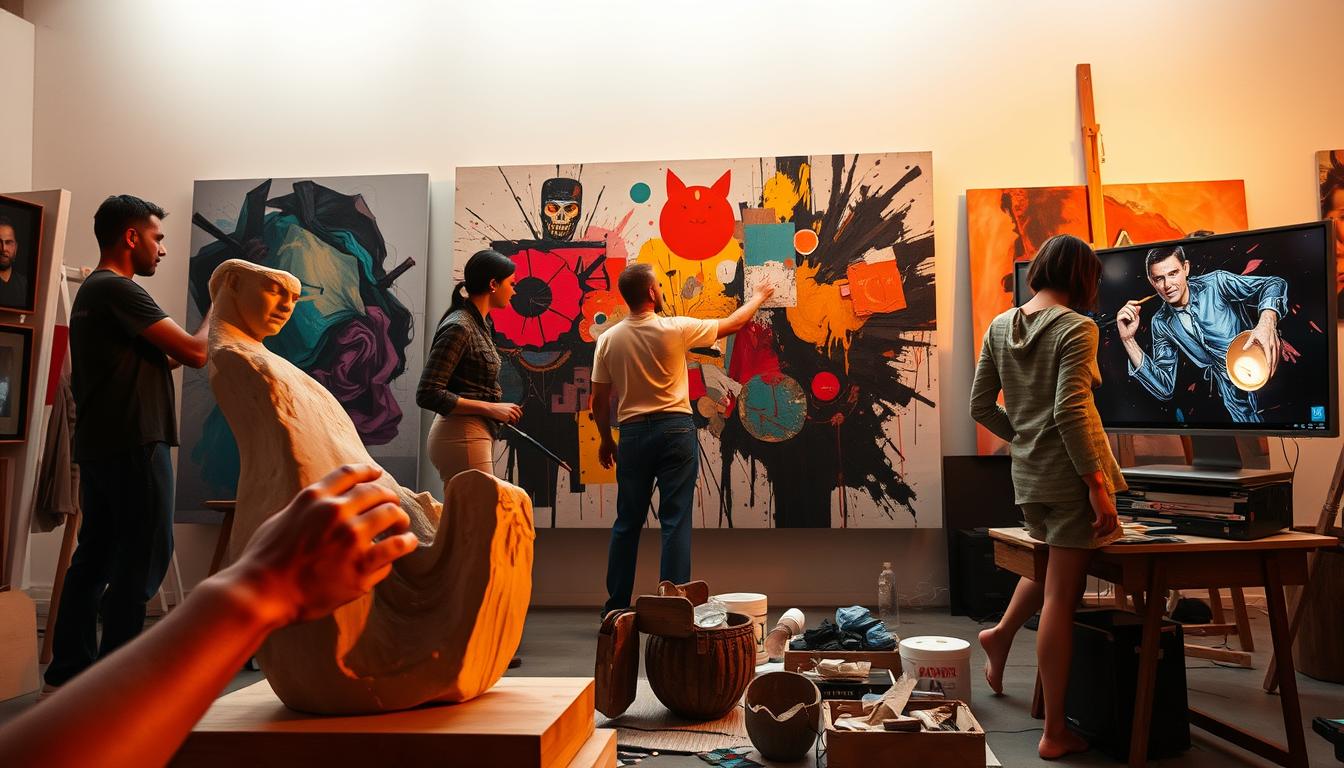
Mixed media is the norm in today’s studios, with 60% of artists combining tech and tactile materials. These artists don’t just adapt; they question what art can be. From Butler’s needlework to Weiwei’s porcelain seas, their work shows that creativity blooms where old and new meet.
Musicians Who Revolutionized Genres
Music’s creative visionaries have changed the sound of music. Jimi Hendrix’s 1967 Monterey Pop Festival performance mixed rock with new sounds. He turned the electric guitar into a tool for new sounds.
His revolutionary art techniques—like burning his Fender Stratocaster onstage—shocked people. But he showed what live music could do. Eddie Van Halen’s two-handed tapping technique, seen in “Eruption,” changed guitar playing. It became a guide for guitarists everywhere.

Ravi Shankar’s work with The Beatles brought raga melodies to pop. Chuck D of Public Enemy said hip-hop was like CNN. Their 1988 album *It Takes a Nation of Millions to Hold Us Back* mixed strong lyrics with samples.
Daft Punk’s 1997 album *Homework* mixed robotic beats with human feelings. This started the French house movement. These innovative artists didn’t just follow trends—they broke them.
Keith Moon’s explosive drumming for The Who and Radiohead’s OK Computer changed music. They mixed rock with digital sounds. Their work shows music’s power is in changing and growing.
Filmmakers Who Altered Cinematic Narratives
Artists like Stan Brakhage changed how we see stories on film. He made over 350 films, including the Dog Star Man series. His 1971 film The Act of Seeing with One’s Own Eyes showed raw images of surgeries, pushing what we see in movies.
Brakhage’s work is celebrated at MoMA and at the University of Colorado Boulder. His archives inspire new filmmakers.
Greats like Akira Kurosawa and Alfred Hitchcock set the stage for today’s films. Kurosawa’s Seven Samurai introduced the Nine Act Structure, seen in Indiana Jones. Hitchcock’s Psycho is famous for its suspenseful shower scene.
Quentin Tarantino’s Pulp Fiction broke the mold of linear storytelling. Christopher Nolan’s Inception mixed philosophy with big-screen action. George Lucas’s Star Wars and James Cameron’s Avatar took CGI to new heights, changing what we expect from movies.
Cinema’s growth comes from teamwork. Directors, cinematographers, and editors work together. Brakhage’s film scratches and Lucas’s Industrial Light & Magic show this teamwork.
From David Lynch’s dreamlike scenes to Martin Scorsese’s tribute to Brakhage, they keep cinema alive. Their work pushes boundaries, making sure each new generation redefines what film can do.
Writers Who Transformed Literature
Writers like creative visionaries have changed literature’s limits. They use revolutionary art techniques to tell stories in new ways. This includes breaking up stories and trying digital methods.
These artists who redefined their craft were often doubted. But they inspired many to follow in their footsteps.
Chimamanda Ngozi Adichie’s Americanah mixes memoir and fiction. It talks about race and identity in a fresh way. This method, once seen as odd, now shapes literature worldwide.
Claudia Rankine’s Citizen: An American Lyric combines poetry and essay. It uses revolutionary art techniques to show racial issues through personal stories.
Yaa Gyasi’s Homegoing follows generations of a family. It shows how stories can cover long periods and places.
Rachel Cusk’s Outline trilogy focuses on dialogue and observation. It creates deep, immersive stories.
Margaret Atwood uses Instagram for her stories, blending text and images. Her The Testaments brings dystopian themes into today’s world. It shows even famous writers can keep innovating.
These writers’ work shows how literature evolves, just like other arts. They have a big impact across different fields.
Influential Designers Shaping Modern Aesthetics
Mira Nakashima combines her father George’s legacy with new designs. Her sofas update his “butterfly” joints, showing groundbreaking artists can respect tradition and innovate. This mix keeps old techniques alive in today’s homes.
Today, visionary craftspeople are changing fashion, architecture, and digital worlds. They use sustainable materials and striking designs, blending style with ethics. A sofa is more than furniture; it’s a symbol of responsibility and creativity.
Artistic innovation happens where old meets new. Designers like Nakashima show how objects can change culture. They use eco-friendly materials and tech to meet today’s needs. Every piece, from chairs to apps, shows values like sustainability and inclusivity, shaping our daily lives.
Photographers Pushing the Limits of Their Craft
Photography has grown thanks to medium-defying artists who don’t follow old rules. Tetsuya Noda is a great example. He mixes old woodblock printing with new photography for his Diary series.
By using both old and new, Noda changes how we see art. He captures quick moments at home, breaking Japan’s art traditions.

Pioneering creatives like Rankin have also changed photography. He co-founded Dazed & Confused and focused on youth culture. His work mixes fashion, music, and activism.
In 2024, Rankin’s work will be shown in London. It includes portraits of famous people like Queen Elizabeth II and Madonna. This shows how photography can do more than just document.
Vivian Maier’s street photos of Chicago were found later. They show how some artists can change history even after they’re gone.
Today, photographers like Carrie Mae Weems and Andreas Gursky use new ways to make art. They use helicopters and AI to create their work. Ansel Adams said, “You don’t take a photograph—you make it.” This idea inspires them to see the camera as a way to explore new worlds.
Performers Altering the Landscape of Dance and Theater
Artists like Tania Bruguera are changing how we see performance. Her 2009 piece “Tatlin’s Whisper #6” turned a Havana gallery into a space for free political talks. This shows how art can really make a difference.
Dance theater now combines movement with technology. Choreographers like Pina Bausch and the Nederlands Dans Theatre mix new and old styles. They tell stories that make us think differently.
Merce Cunningham and Akram Khan are leading the way with new dance styles. They use digital tools like VR and motion capture. This lets performers show more than ever before.
Bruno Beltrão’s H3 uses street dance to talk about city problems. Liz Lerman works with people who aren’t professional performers. She shows that anyone can be on stage.
Global projects are also changing dance and theater. Cuban ruedas and hip-hop mix, and Japanese butoh meets AI visuals. The South Bronx Culture Trail lets communities create their own shows. These efforts show that theater can touch everyone’s lives.
Sculptors Who Are Redefining Three-Dimensional Art
Artists like Richard Hunt blend old and new. His metal sculptures mix bronze and steel, creating unique shapes. He says these shapes are like what Nature might make with heat and steel.
“Sculpture isn’t just material—it’s a conversation with space.”
Linda Lighton uses ceramics to make social points. Her “Taking Aim” series critiques gender and violence with lipstick-shaped casings. This shows how artists can tell new stories with sculpture.
Artists like Rirkrit Tiravanija and Monika Horcicova use new methods. They create 3D-printed bonsai trees and plaster composites. Wieki Somers even turned ashes into art, exploring death.

These artists also change how we see space. Theo Jansen’s Strandbeests are wind-powered and mix art and engineering. Nick Ervinck’s huge acrylic pieces play with light and scale.
Today’s sculpture is interactive. Shane Hope’s molecular models on acrylic challenge us to see science as art. By combining tradition and technology, sculptors show that three dimensions are endless.
Conclusion: The Ongoing Journey of Artistic Innovation
Artistic innovation comes from creative visionaries who change how we see art. Ruth Becker and AI collaborations show how tradition meets new tools. Today, artists use digital tech like AI to create. Tools like NVIDIA’s GauGAN and IBM’s Watson help, not replace, human creativity.
Mario Klingemann and Refik Anadol show what humans and AI can do together. Their work opens up new ways to express ourselves. This shows that human-AI partnerships can lead to new artistic possibilities.
Most artists, 70%, see AI as a partner, not a competitor. Tools like Runway ML and AIVA help artists create in new ways. But, 85% of art professionals want to know how AI is used.
As AI-generated art grows 15% each year, keeping ethics in mind is vital. This balance is key to the art world’s future.
Art evolves when artists are open to change. AI’s rise is like past changes, from oil paints to photography. Each change was met with doubt but expanded our creative reach.
The Next Rembrandt project shows how old and new can mix. It’s a blend of data and tradition. Workshops help artists learn AI, increasing their skills by 50%.
Supporting creative visionaries is more important than ever. Their work reflects our world’s complexities. It offers new ways to see technology, environment, and identity.
The journey of artistic innovation is ongoing. It’s a mix of past and future. The next chapter is being written by those who dare to reimagine art.