







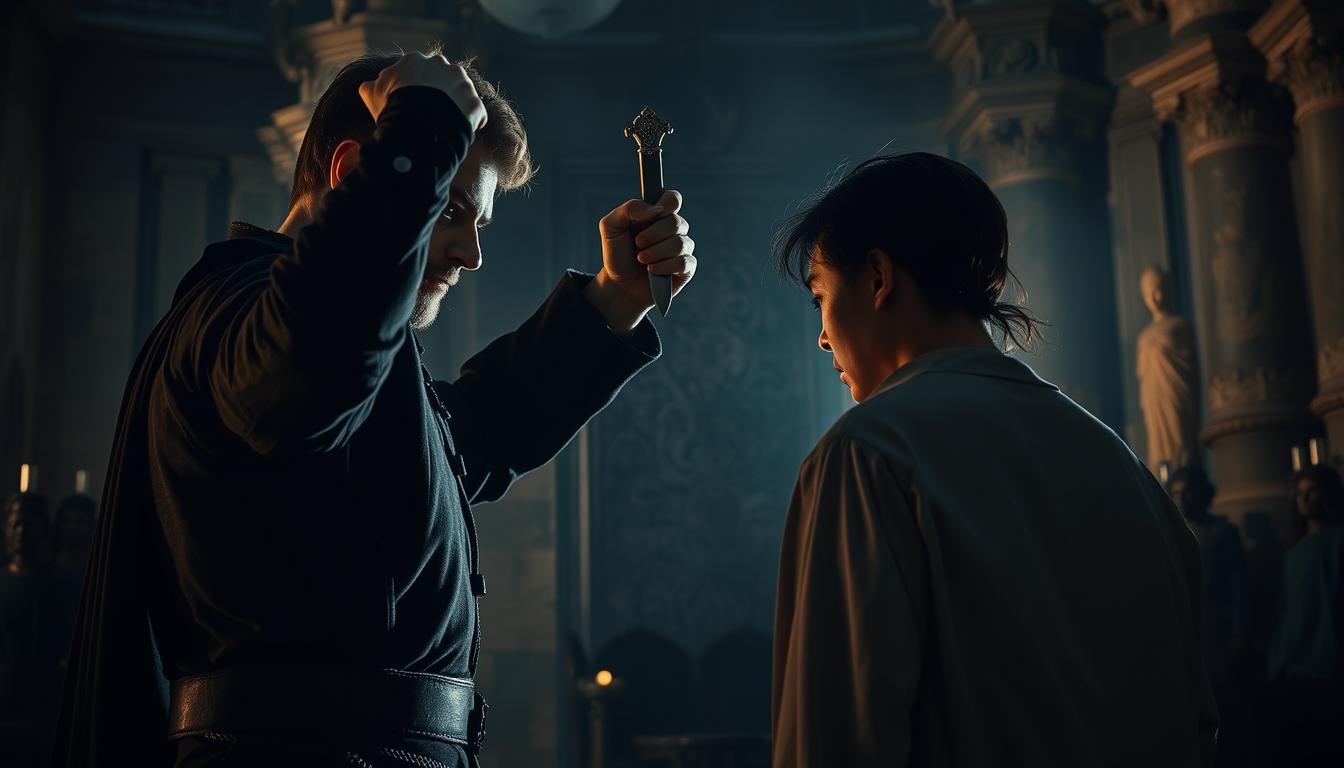
History’s most famous historical betrayal—like Mir Jafar’s secret pact enabling British victory at Plassey—show how trust’s collapse can reshape nations. From the shocking betrayal in history of the Rosenbergs selling atomic secrets to Benedict Arnold’s plot to hand West Point to the British, these acts of historical treachery altered wars and empires. Each notorious betrayal reveals how one disloyal choice could spark global consequences, proving betrayal’s power to redefine civilizations.
These tales—whether ancient myths like Agamemnon’s sacrificial betrayal or the Gunpowder Plot’s explosives—expose how trust’s end often becomes history’s hidden turning point. Explore how even small acts of disloyalty ignited empires’ rise or fall, shaping the world we live in today.
Defining Betrayal: A Historical Perspective
Looking into historical definitions of betrayal shows how cultures viewed it. In ancient times, like in Greece, Rome, and Egypt, betrayal was seen as a danger to the state. In Sparta, leaving the army meant death. Egypt’s pharaohs executed traitors publicly.
These betrayal in ancient societies rules put the group’s needs first. They saw loyalty as key to survival.

As time went on, evolution of treachery changed with society’s values. In medieval Europe, betrayal was tied to loyalty to lords. If vassals broke their oath, they faced severe punishment.
Renaissance thinkers, like Machiavelli, questioned if betrayal could be used for political gain. This made moral lines blurry. These cultural perspectives on betrayal show how power shapes its meaning.
Early laws, like Hammurabi’s, had harsh penalties for betrayal. This shows how important trust was in society. Today, ancient ideas of betrayal, like Rome’s *maiestas* laws, are seen in modern laws. This shows betrayal’s lasting impact and its reflection of each era’s values.
Julius Caesar and the Ides of March
On March 15, 44 BCE, Julius Caesar was stabbed 23 times in the Theatre of Pompey. Marcus Brutus, his trusted ally, was among the attackers. This act of Roman political betrayal changed history. Caesar’s last words, “Et tu, Brute?” showed his shock at being betrayed by a friend.

Caesar’s rise as dictator made the Republic unstable. Senators, including Brutus, feared his power. They saw him as a tyrant and plotted against him to save the Republic.
But their plan failed. The Brutus and Caesar bond showed the conflict between loyalty and duty. This event marked a turning point in Roman history.
“Liberty! Freedom! Tyranny is dead!”
Despite calling it liberation, chaos followed. Civil wars broke out, and Caesar’s heir, Augustus, took power. This marked the end of the Republic and the start of the Roman Empire. Today, the Ides of March reminds us of the dangers of trust and tyranny.
Mary Queen of Scots: A Life of Treachery
Mary became queen of France and Scotland at just six days old. She was thrown into a world of royal treachery. Her early years were filled with political marriages and betrayals.
At five, she was sent to France to marry Francis II. But his death in 1560 made her return to Scotland. There, she faced Scottish historical betrayals from nobles.
In 1567, her husband Lord Darnley was assassinated. This act implicated her third husband, the Earl of Bothwell. Fleeing to England, Mary hoped for Elizabeth I’s help. But her cousin’s court saw her as a threat. 
Elizabeth’s advisors pushed for Mary’s execution. They used the Babington Plot and forged “casket letters” as evidence. After 19 years in captivity, Mary was beheaded in 1587.
Though Elizabeth called her a “cursed woman,” the execution showed Tudor paranoia. Mary’s story shows how gender and power mixed. Female rulers were often seen as threats just for being women.
Her son James VI, later James I of England, united the thrones. But his mother’s life served as a warning about the cost of betrayal.
The American Revolutionary War: Benedict Arnold’s Defection
Benedict Arnold’s story is one of heroism turned to Benedict Arnold betrayal. He was celebrated for capturing Fort Ticonderoga and leading at Saratoga. His military skills made him famous.
But, personal issues and financial troubles fueled his resentment. He was wounded in battle, his leg shattered at Saratoga. He felt unappreciated. By 1780, his plan to hand West Point to the British showed a stark turn from American Revolution treachery.
The famous American traitor plotted with British spy John André, demanding 20,000 pounds. When André was caught with incriminating papers, Arnold fled. His escape left a legacy of Revolutionary War betrayal that shocked the nation.
Today, the Saratoga Boot Monument honors his leg wound. It acknowledges his bravery while highlighting his fall. His actions in 1780 tested trust in leadership, a theme echoing through American history. From battlefield hero to traitor, Arnold’s tale is a cautionary study of pride, greed, and loyalty’s fracture.
The Role of Espionage in Historical Betrayals
Historical espionage is a world of secrets and lies. The Cambridge Five is a prime example. These British officers secretly worked for the Soviet Union. Kim Philby, a key member, climbed the ranks in MI6 while sharing secrets with Moscow. His 1963 switch to the Soviet side showed how deep double agents could go.

People betrayed for many reasons. Some, like physicist Theodore Hall, leaked atomic secrets to the USSR during the Manhattan Project. Others, like Aldrich Ames, sold CIA secrets for cash until 1994. These actions changed the world, revealing weaknesses in trust between countries.
Earlier betrayals also left deep marks. The 1941 Duquesne Spy Ring case was the largest US espionage conviction. It uncovered a Nazi spy ring in America. Double agents like James Armistead helped the Patriots by giving false info to the British. But, it came at a high cost: lives were lost, and alliances were broken.
These stories show the moral complexity of espionage. Double agents often struggled with loyalty. Philby’s secrecy hurt his personal life, while Hall’s actions showed the ethical price of betrayal. These secret battles remind us that trust in espionage is very fragile. It has shaped history in ways we’re only starting to understand.
Betrayal in Literature and Mythology
Stories of betrayal in ancient myths show our endless interest in trust’s weakness. Greek gods like Zeus, who cheated on his wife Hera with mortals, are examples. His actions led to jealousy and revenge, just like in human lives.
Hera’s anger towards Zeus’s children shows how betrayal can break even divine bonds.
Literary betrayals are found across cultures and time. In Othello by Shakespeare, Iago uses jealousy to destroy Othello. King Lear shows how family betrayal can hurt deeply. Dante’s Inferno pictures traitors stuck in ice, showing how trust can never be fixed.
Modern stories like The Kite Runner explore guilt and making amends after betraying someone as a child.
“Friend, do you betray me with a kiss?”
The Judas archetype goes beyond religion, symbolizing greed and moral failure. His thirty silver coins remind us of stories where greed leads to betrayal, like Shakespeare’s Shylock. Betrayal stories also teach us about loyalty and the pain of broken trust.
Betrayals That Shaped Nations
History’s most shocking betrayals changed lives and shaped nations. The Glencoe Massacre in 1692 and the 1440 Black Dinner are prime examples of historical political betrayal. Clan Campbell’s attack on Clan MacDonald guests was a nation-changing betrayal that split Scotland for generations.
These acts broke sacred hospitality codes, leaving deep scars on Scotland’s politics.
Such betrayal in nation-building often caused big changes. The Black Dinner’s execution of Stewart heirs weakened the Scottish monarchy. Later, the 1772 Partition of Poland, done through secret treaties, showed how trustless alliances can erase nations.
These events show how political betrayal can change borders and identities.
Today, these betrayals are seen as symbols of resilience. Scotland’s Glencoe memorial honors the victims, while Poland’s museums face its divided history. Nations rebuild by facing their past wrongs to unite.
These stories show that even the cruelest betrayals can unite a nation. They teach us about trust and power today.
The Emotional Toll of Betrayal
History’s greatest betrayals leave deep scars. The psychological impact of betrayal lasts for generations. It shapes how societies heal or fail to heal from wounds like Napoleon’s historical trauma after Marshal Ney’s desertion.
Even centuries later, the betrayal’s emotional legacy remains. It changes how we trust and see ourselves.
Trust is like a jar of marbles. Each broken promise weakens it. Studies show that to cope with historical betrayal, we must rebuild this jar through open communication.
Relationships that thrive have partners who actively nurture emotional availability. Disengagement—silent withdrawal—can hurt as much as overt lies. It makes people feel they’re “unlovable” due to unresolved shame.
“Vulnerability shared with those who earn it fosters deeper bonds,” writes Brené Brown in *Daring Greatly*, highlighting the importance of boundaries to rebuild trust after betrayal.
Research shows that betrayal trauma affects mental health uniquely. Those who endure caregiver betrayal often face “betrayal blindness.” This is a subconscious refusal to acknowledge harm.
This pattern is linked to shorter telomeres, a sign of cellular aging. It shows how prolonged stress from such trauma physically ages us. Yet, there is hope: therapy helps reframe these experiences. It teaches resilience through shame resilience—embracing pain without losing self-worth.
The journey to healing starts with honesty. Rebuilding trust requires courage to confront the past and nurture secure attachment. History teaches us: trust can be repaired, one marble at a time.
Lessons Learned: Moving Forward from Betrayal
History’s darkest betrayals teach us that trust must be courageously rebuilt. From Julius Caesar’s assassination to today’s betrayals, the journey to healing from historical betrayals begins with understanding recovery. South Africa’s Truth and Reconciliation Commission shows us that historical reconciliation involves acknowledging past hurts and holding people accountable. These examples give us lessons from betrayal that are relevant today.
Recovering from betrayal also depends on support. Studies show that over 75% of therapy patients feel less distressed. Rebuilding trust takes time, but setting clear boundaries and talking openly can help. Over 70% of couples who set new limits feel safer, showing that overcoming treachery begins with small steps.
History teaches us that healing from betrayal is not straightforward. Jennifer Freyd’s research on betrayal trauma shows how it can leave deep scars. Yet, resilience grows through self-care like exercise, journaling, and therapy. It helps 60% of people manage their symptoms. The important thing is to recognize betrayal’s impact and choose to rebuild, whether in personal relationships or national policies.
Every betrayal leaves a mark, but it doesn’t have to define us. By learning from past mistakes and valuing honesty, we can turn pain into progress. History’s betrayals teach us that while trust is fragile, repairing it strengthens lasting bonds.