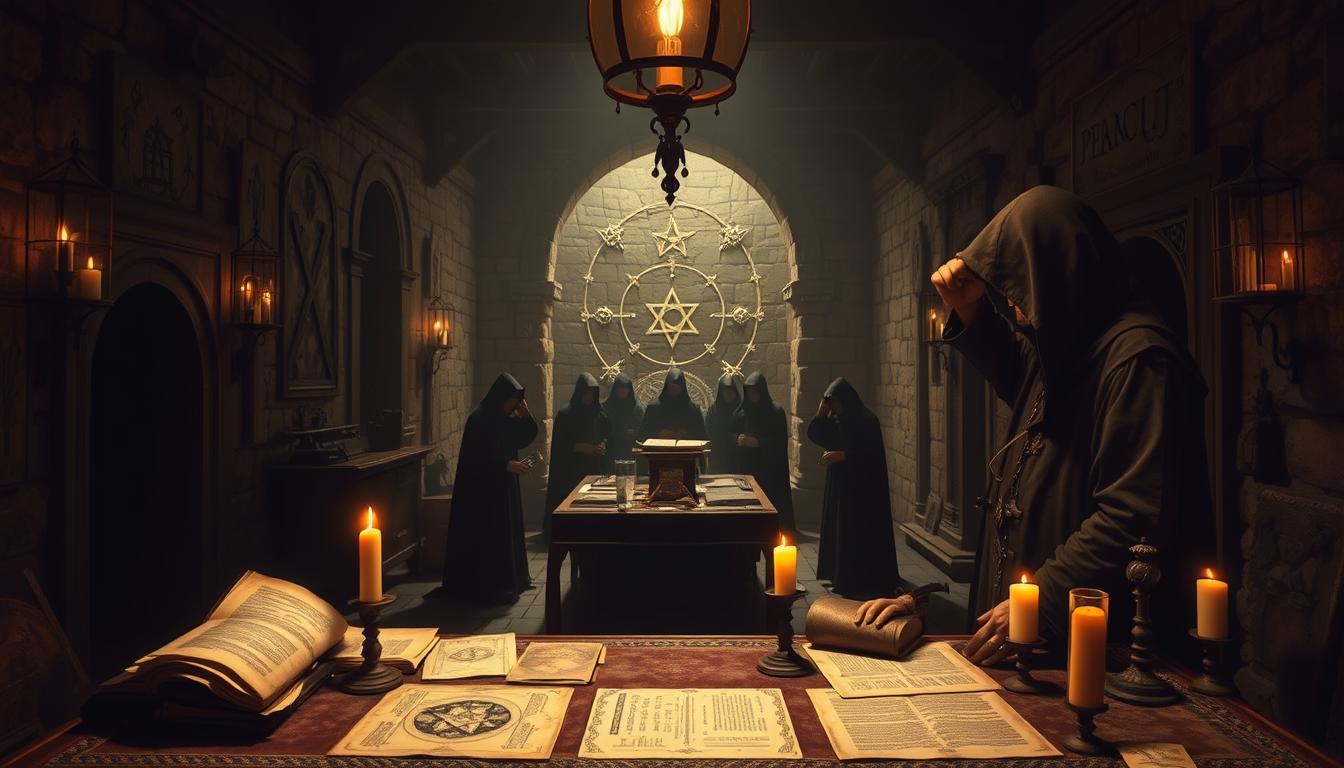
Secret societies have played a big role in history for centuries. They started with ancient groups and continue today with hidden brotherhoods. These groups often used rituals like blood oaths and special robes to connect members.
The Hongmen society, founded in 386 CE, had a unique initiation. Initiates had to pass three gates and mix their blood with wine. This mix of tradition and unity was key to their bond.
In ancient Egypt, mystery cults were common. The Knights Templar, dissolved in 1312, also played a significant role. The Catholic Church banned Freemasons in 1738, but 13 U.S. Constitution signers were Freemasons. Today, groups like Skull and Bones at Yale and the Bilderberg Meeting continue to operate, balancing secrecy with influence.
These secret groups have always been mysterious. They guarded religious truths or shaped politics. Their rituals, like the Knights Templar’s wealth or the Illuminati’s 1776 roots, spark debates about power and secrecy. Discover how these hidden brotherhoods blend history with modern intrigue.
What Are Secret Societies?
Secret societies are groups with their own rules and traditions. They are exclusive and require new members to go through secret rituals. These rituals show loyalty to the group.
They keep their activities hidden to protect their secrets. These groups have secret symbols and initiation rites. This makes members feel special and different from others.
For example, the Hongmen society in China has a long history of secrecy. New members take blood oaths and change their clothes as part of their initiation. These rituals help show their commitment and hierarchy.
Even today, groups like Freemasons keep their rituals secret. They do this even though many people know they exist.
“By blood and bond, I serve the brotherhood.”
Groups like Italy’s Carbonari and Nigeria’s Ekpe society use secrecy to reach their goals. These goals can be political or cultural. Members promise to keep secrets, and breaking this promise can be very serious.
In places where these groups are banned, like Italy and Poland, they continue secretly. Their rituals and traditions help keep the group united and focused over time.
The Origins of Secret Societies
Secret societies have their roots in ancient times. In places like Egypt, Greece, and Rome, mystery schools and esoteric knowledge were key. Initiates learned sacred rituals to unlock deeper truths.
Groups like the Pythagorean Brotherhood and Dionysian cults used symbols and myths. These ancient secret societies tested members to ensure only the worthy joined their inner circles.

In the Middle Ages, these traditions evolved. The Knights Templar, founded in 1118, combined Christian faith with knightly codes. This became a model for later groups.
China’s Hongmen society, started in 386 CE, used blood oaths and rituals similar to Western Freemasonry. These groups kept knowledge secret, creating strong bonds of loyalty.
Modern Freemasonry, starting in 1717, comes from medieval stonemason guilds and ancient symbols. Its initiation degrees reflect the layered esoteric knowledge of old. Today, groups like the Veiled Prophet of Khorassan keep these traditions alive. They show how humans have always sought meaning through shared, secret wisdom.
The Freemasons: A Case Study
Freemasonry’s roots go back to the 18th century and the Enlightenment. It started as a group of stonemasons and grew into a brotherhood focused on philosophy. By 1717, the first Grand Lodge was set up in England, showing a move towards deeper ideas.
Today, Masonic lodges around the world have members who work on their moral and intellectual growth. They use symbols like the square and compasses. These symbols are key to and stand for ethics and self-improvement.

There are over 6 million Freemasons worldwide, with 898,000 in the U.S. They focus on charity and helping their communities. Famous members include George Washington and Wolfgang Amadeus Mozart, showing the group’s long history.
Modern follow traditions like the three-degree system. This system has three levels: Entered Apprentice, Fellowcraft, and Master Mason. It shows the journey of learning. But, the number of members has gone down as groups like the Shriners change with the times.
“The loss of mystique around secrecy may explain why fewer join today,” noted historian John Dickie in 2020.
There are ongoing debates and controversies, like the Catholic Church’s ban on Freemasonry. Some lodges are only for men, but others, like co-Masonic groups, welcome women. Symbols like the all-seeing eye are seen in pop culture, but their true meanings are often lost.
As Freemasonry faces the challenges of today, its legacy as a symbol of unity and mystery continues.
The Illuminati: Myth vs. Reality
The Illuminati origins go back to 1776, when Adam Weishaupt started the Bavarian Illuminati in Ingolstadt. It was meant to spread Enlightenment ideas, but it grew too big and faced opposition. By 1785, Bavaria banned it, ending its life.
Weishaupt, the leader, was forced out but kept writing until his death in 1830. Historians agree the group was gone by 1787. There are no secret documents left, and no modern groups claim to be its heirs.

Today, Illuminati conspiracy theories say a secret group controls politics and media. These ideas started to spread after the 1975 Illuminatus Trilogy and Dan Brown’s 2009 Angels & Demons. Critics say these theories are too simple and don’t match the real history.
The Bavarian Illuminati aimed to challenge the monarchy and church. This is far from the global control plots people imagine today.
Despite the lack of evidence, global influence theories continue. Symbols like the All-Seeing Eye on U.S. currency are linked to Freemasonry, not the Illuminati. Yet, movies and social media keep the myth alive. Understanding the difference between fact and fiction helps us see how history inspires stories today. The truth is, the Bavarian Illuminati is gone, but its name sparks distrust in power.
Secret Societies in American History
American secret societies have played a big role in shaping the country’s politics and society. In the Revolutionary era, groups like the Committees of Safety worked secretly to fight against British rule. Later, fraternal orders like the Odd Fellows and Elks helped people in need before there was welfare.
These fraternal orders reached their peak in the 19th century, with millions joining. University secret societies, like Yale’s Skull and Bones, also became important. Founded in 1832, it has had many influential alumni, including presidents and CIA directors.
The Jekyll Island Club, where big names like J.P. Morgan met, secretly planned the Federal Reserve in 1910. This secrecy led to many conspiracy theories about hidden powers.

Some groups, like the Shriners, used their secrecy to help children’s hospitals. But others, like the Ku Klux Klan, used it to enforce white supremacy. Today, while fewer people join, their impact is felt. Skull and Bones continues to attract top students, keeping its allure alive.
From the early days of rebellion to today’s politics, secret societies have left their mark on America’s history.
Women in Secret Societies
Many secret societies once kept women out. But, women’s secret societies grew as places for female leadership and support. The Order of the Eastern Star, started in 1850 by Dr. Rob Morris, was one of the first women’s fraternal organizations linked to Freemasonry.
This group let female relatives of Freemasons join in rituals and charity work. By the 1860s, eleven chapters formed in Minnesota. By 1878, five of these chapters joined to form the Minnesota Grand Chapter, a big step for gender in secret orders.
Women like Louise Lyon Johnson made history, leading the Minneapolis Chapter in 1895. Groups like the Daughters of Rebekah, linked to the Odd Fellows, focused on helping others. The 20th century saw changes, like the Belizean Grove, founded in 2001 for women professionals.
Even today, groups like the Bohemian Club are mostly men. But, the female Freemasons of the Eastern Star now welcome all genders in some places. This change shows how society is evolving. These groups are shaping history, showing women’s roles in secret orders are both a legacy and an ongoing journey.
The Role of Secret Societies in Politics
Secret societies have long been a topic of debate in politics. Groups like the Freemasons played a big role in shaping early U.S. policies. Many Founding Fathers were members, adding to the intrigue.
Today, theories about secret government control often point to groups like the Bilderberg Group and Council on Foreign Relations. These groups bring together world leaders to talk about global issues. This has led to suspicions about whether they make decisions together.
Skull and Bones, started at Yale in 1832, shows how exclusive groups can wield power. Both George H.W. and George W. Bush were members, showing a path to politics. Critics say these groups can skew policy-making, but supporters argue they are just part of the political landscape.
Global governance theories often focus on international groups. The Trilateral Commission, for example, holds meetings with economists and policymakers. But, they say they aim to promote dialogue, not control governments. It’s important to separate fact from fiction, as some ties are real, but claims of a “shadow government” are not supported.
The role of secret societies in politics is a mix of truth and myth. While some, like the Freemasons, have definitely influenced policies, claims of global control are not proven. Encouraging critical thinking helps us understand these groups without ignoring real concerns about power and transparency.
Popular Culture and Secret Societies
Secret societies in fiction are key in today’s conspiracy entertainment. Books like Dan Brown’s novels about secret orders and big movies grab our attention. They mix mystery with real intrigue, making us wonder.
Shows like The X-Files and movies like National Treasure turn history into exciting stories. They mix truth with fantasy, making us question what’s real.
Stories like The Count of Monte Cristo and Watchmen use secret societies to explore power and secrets. Movies like Da Vinci Code show how these groups can shape history. Online games and forums let us dive deeper into these stories.
“Bonesmen have controlled the fortunes of major American families,” noted a Time analysis, showing how real-world groups inspire fictional tropes. Yet creators balance creativity with caution, avoiding direct ties to actual organizations.
These stories entertain us but also make us curious about real secret societies. It’s important to know the difference between fiction and history. This way, we can enjoy the stories while staying informed.
The Future of Secret Societies
Modern secret societies face a world where digital age secrecy is both challenged and reshaped. Freemasons now share histories openly online while protecting core rituals, showing evolving traditions. Online forums and encrypted apps let contemporary exclusive groups form without physical meeting halls, blending old and new ways of uniting people.
Technology tests how these groups survive. Hacktivist collectives like Anonymous operate in shadows but lack ancient symbols, proving secrecy’s enduring draw. Traditional private organizations update: some host virtual initiations, others focus on charity to stay relevant. The future of private organizations may see hybrid models—part digital, part ritual-based—responding to today’s need for both connection and mystery.
Whether thriving or fading, these groups reflect timeless human desires. People seek belonging and secrets, just as ancient societies did. As technology changes, so will the forms of secrecy. Yet the drive to share knowledge privately, whether in code or cipher, ensures some version of these groups will persist. Their evolution mirrors society’s shifting values, proving that even in a connected world, the pull of the unknown endures.